Clinical records are the invoice’s only source.
Twenty destinations across care, pharmacy, finance, business, people and the workspace, joined by one rule: an invoice line names the procedure, the bed days or the medication course it bills. Looking at it should settle whether operations and revenue can sit in one product without either lying about the other.
Preview interactive design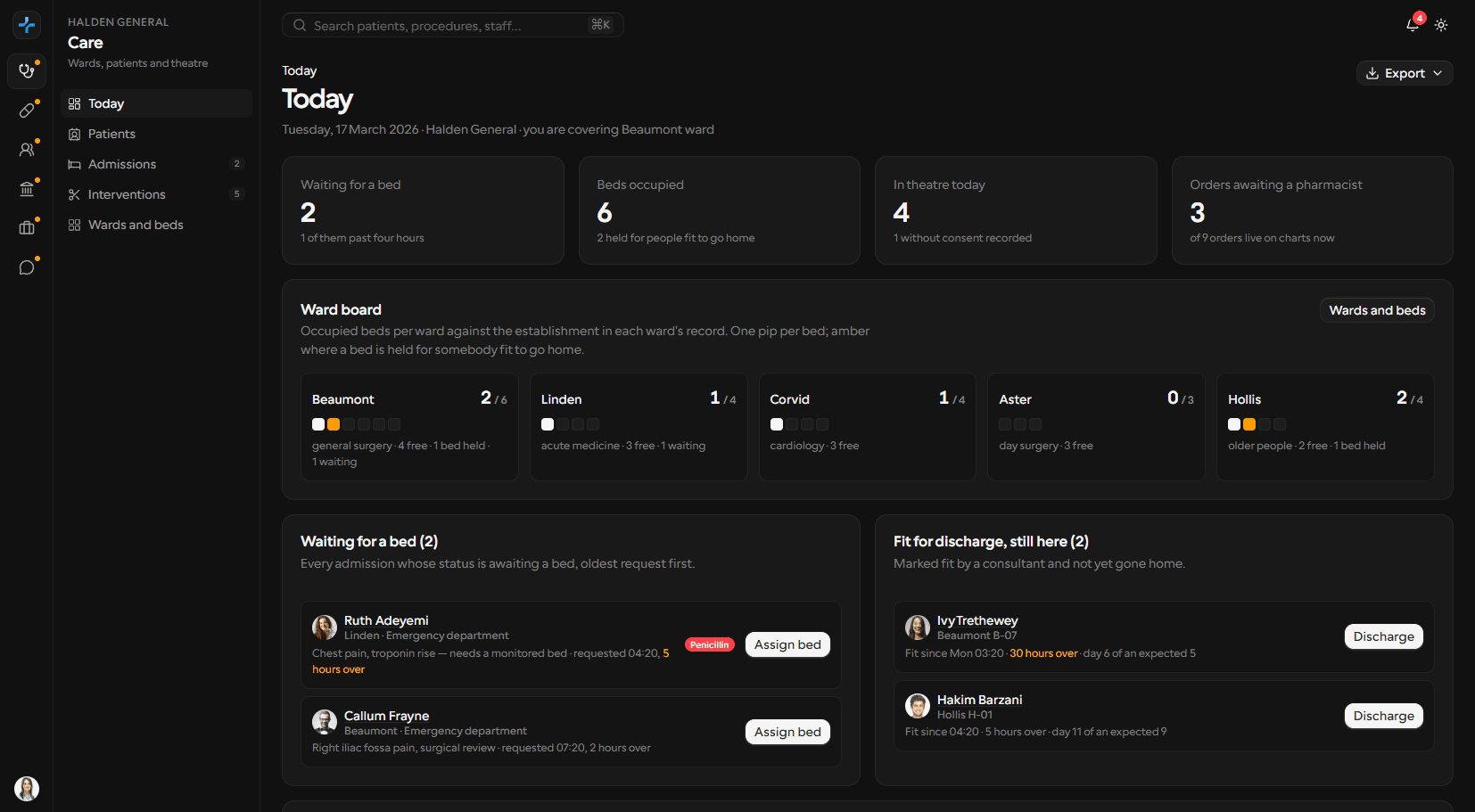
The bed is the constraint, and the invoice is the consequence.
The operator is a ward manager at handover and a finance officer three weeks later, looking at the same records. The constraint is that a bed cannot be created — every admission waiting is somebody in a corridor — and everything billed afterwards has to reconcile to what the ward actually did.
01The screens →Two patients are waiting on a bed, and each clock started when ED requested it rather than when somebody typed a status. A bed is not a route: it is a pip on its ward’s card.
the bed count is a setting, and it divides02TreatThe theatre list is a timed ladder rather than a table, because the question is what happens next and what is late. A procedure will not start without consent on the record.
consent gates the transition, not the button03RecoverCoding turns an episode into lines, each naming the care it bills. Only cleared money moves a balance, terms come from the payer’s own contract, and a disputed invoice is never chased.
pending money is not paid moneyOne record, read by the ward and then by finance.
Forty registered routes: twenty destinations over six rail categories, six records, the profile, seven under settings and six for auth. There is deliberately no /admissions/:id and no bed record — an admission is one row on the ward board, and a bed is only ever reached through its ward.
02The status set →What is waiting on somebody, before anything else
A figure row, the ward board, then the work owed to a person: bed waits, held discharges, the theatre list. No occupancy percentage without the bed count that divides it, and no summing unlike work into one number.
- “Waiting for a bed 2 — 1 of them past four hours”, the oldest requested at 04:20
- One pip per bed against each ward’s own establishment: Beaumont 6, Linden 4, Corvid 4, Aster 3, Hollis 4
- “Fit for discharge, still here (2)” — Ivy Trethewey, 30 hours over, day 6 of an expected 5
The procedure record, and the transitions it will offer
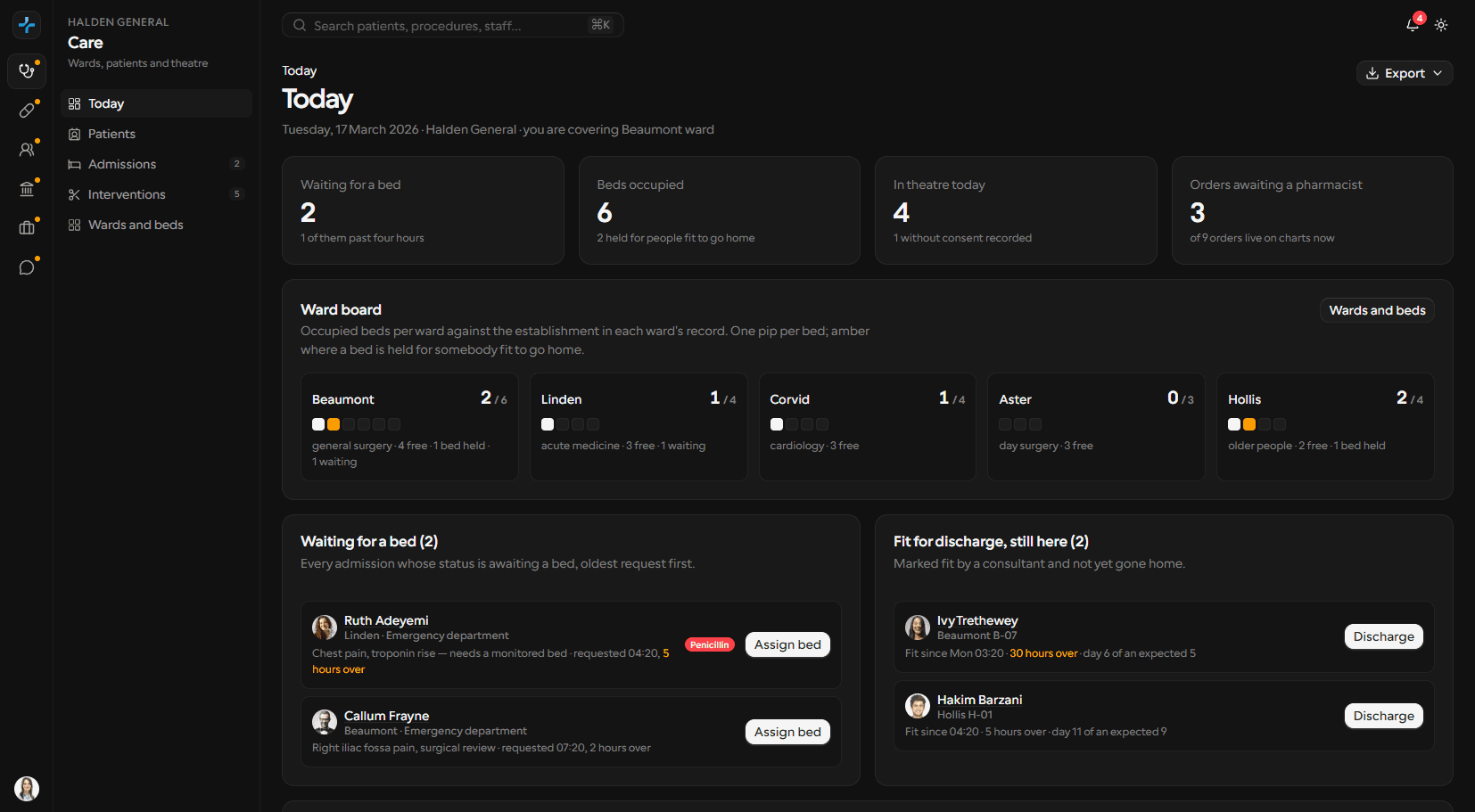
A timed ladder rather than a table, because the question is what is next and what is late. The record carries the clock and the gate: what it is over by, and which transitions exist at all.
- “In theatre” — central line insertion, Theatre 3, started 08:20 and an hour over
- Consent recorded 06:20 on this one; one of the four in theatre today has none
- “Record as abandoned” is danger and cancelled is neutral — one started and could not be finished
Courses grouped by where their dose clock has got to
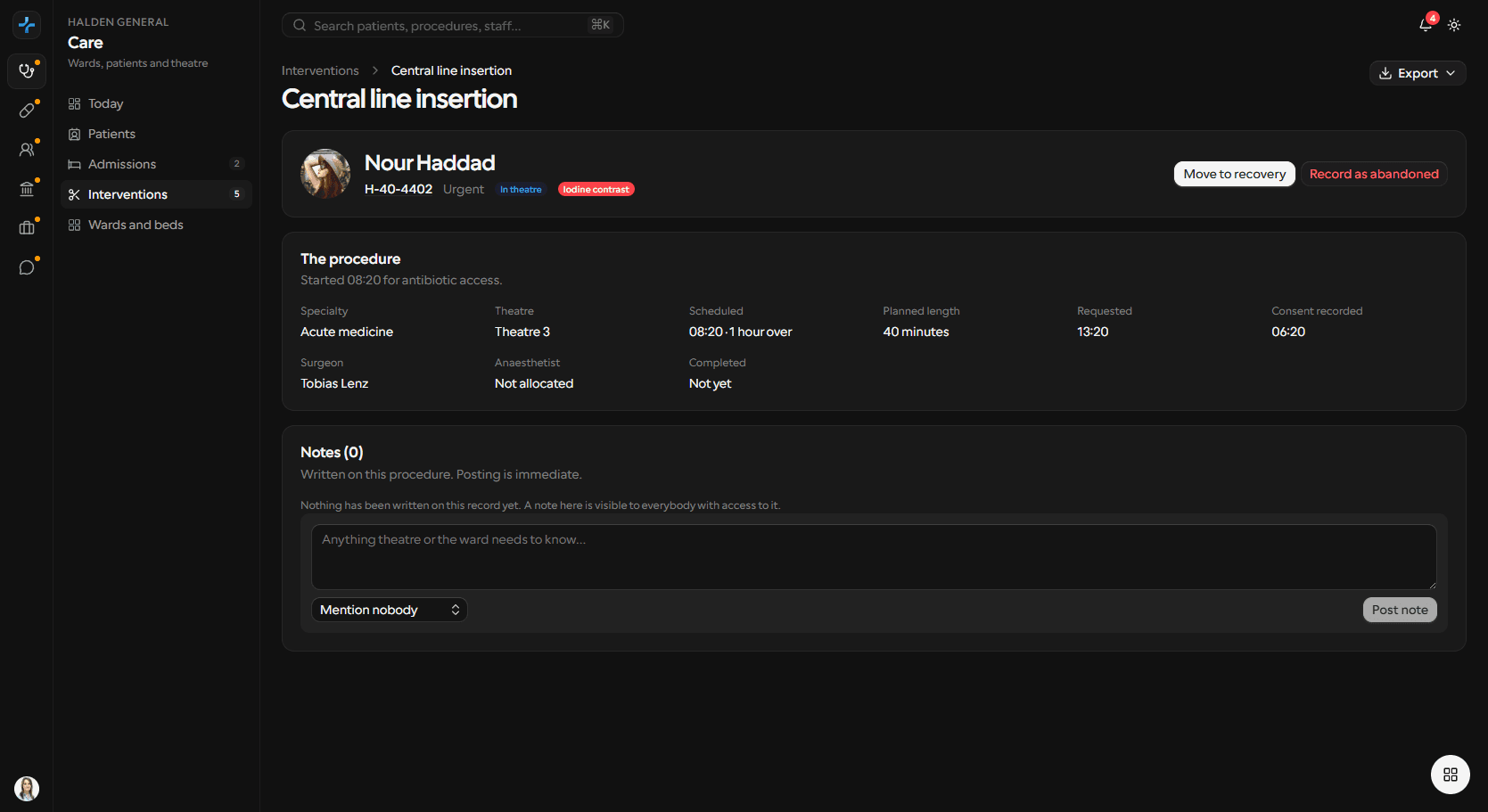
Not a list of prescriptions: what is overdue, due this hour, and later today, derived from each course’s frequency against the clock. Recording a dose moves the next one by that interval.
- Overdue 1, due within the hour 1, later today 4 — one array, cut by the clock
- “Awaiting a pharmacist 3 — not on the round until they are verified”
- Eluned Pryce’s 07:20 paracetamol, two hours over, last given 01:20
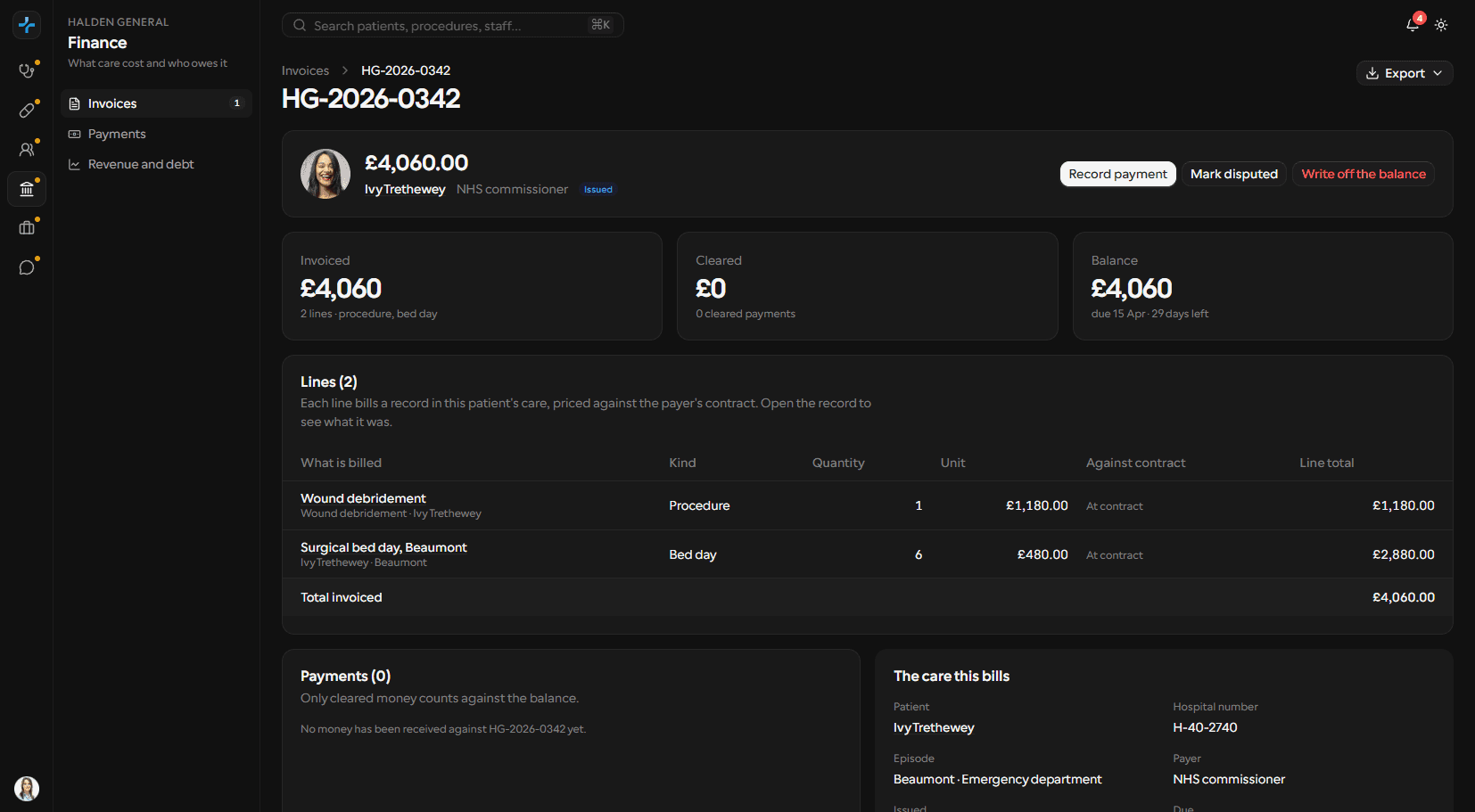
An invoice whose every line names the care it bills
One invoice per episode, each line pointing at the intervention, admission or course behind it. The contracted price is looked up at render, so a line billed off contract is a finding.
- HG-2026-0342 — two lines, £4,060.00 invoiced, £0 cleared, balance £4,060.00
- Six surgical bed days at £480.00 and one debridement at £1,180.00, both at contract
- Due 15 Apr, 29 days left — the commissioner’s own 30-day terms, not a default
The chase list, and the invoice it will not chase
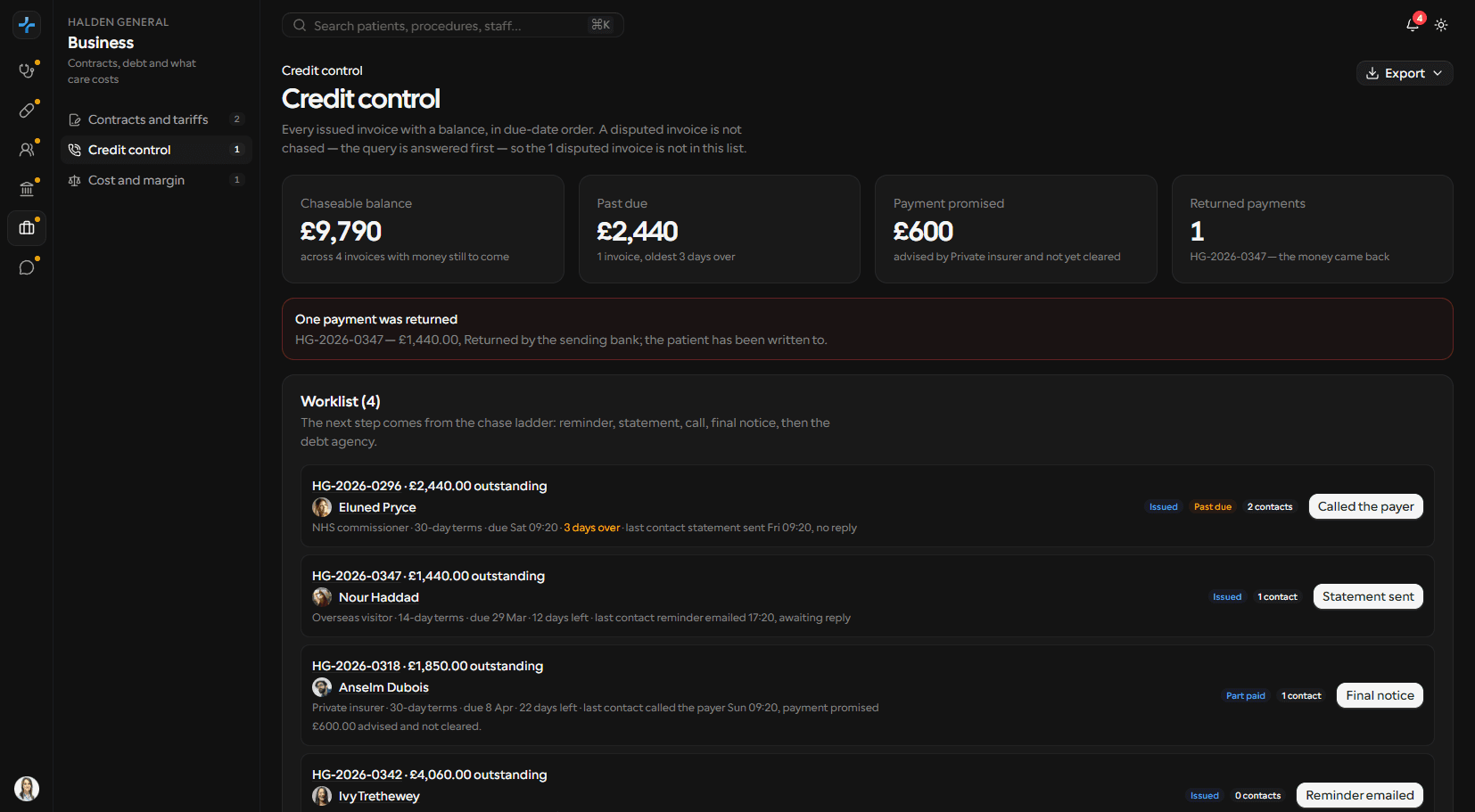
Balance, terms, last contact, and the step the ladder says comes next. Overdue is not stored, so an invoice arrives on this screen without anybody moving it — and a disputed one is never chased.
- £9,790 chaseable across 4 invoices, and the 1 disputed invoice is not among them
- HG-2026-0347 — £1,440.00 returned by the sending bank, and the patient written to
- £600.00 promised by the private insurer moves nothing until it clears
Where an invoice has got to is stored. Whether it is late is not.
The value nobody finds here is overdue: a due date in the past with a balance outstanding, computed at render, so an invoice becomes overdue on its own and the worklist, the aged-debt buckets and the nav badge read one predicate. Expiring is absent for the same reason.
03The awkward cases →The fixture set was written to make screens fail.
All three are records in the fixture rather than hypotheticals, and each one is why a figure on some other screen is derived rather than stored.
04The audit →The contract lookup had to become the join.
The contracted price for a line lived in two places — on the tariff item, and implied by the line’s own unit price — with nothing checking they agreed, so a line billed off contract was invisible unless somebody compared them by eye. The price is looked up at render now, and a line that disagrees is a finding on three screens at once.
05Back to the top →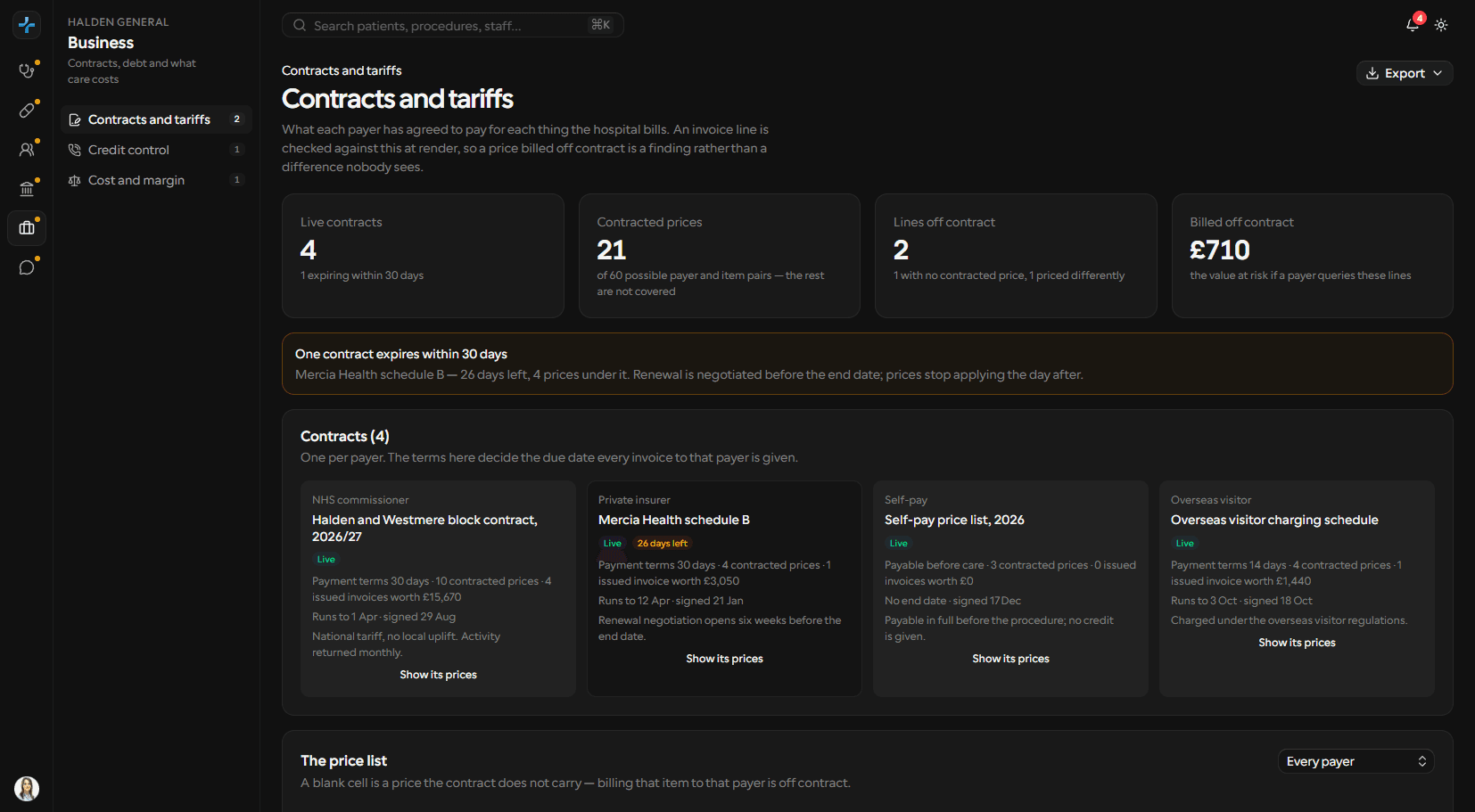
Reckon
One record, both jobs.
Most products split it.
The ward writes the facts and finance bills them months later. If a figure cannot be walked back to the bed day that produced it, it is not a figure — it is a guess with a currency symbol.