A desk that answers to both sides of the deal.
An agency sits between brands who want a campaign booked and creators whose careers turn on what is agreed for them. Both think they are the customer. Money arrives late and leaves later, and nothing here is a single-owner record.
Preview interactive design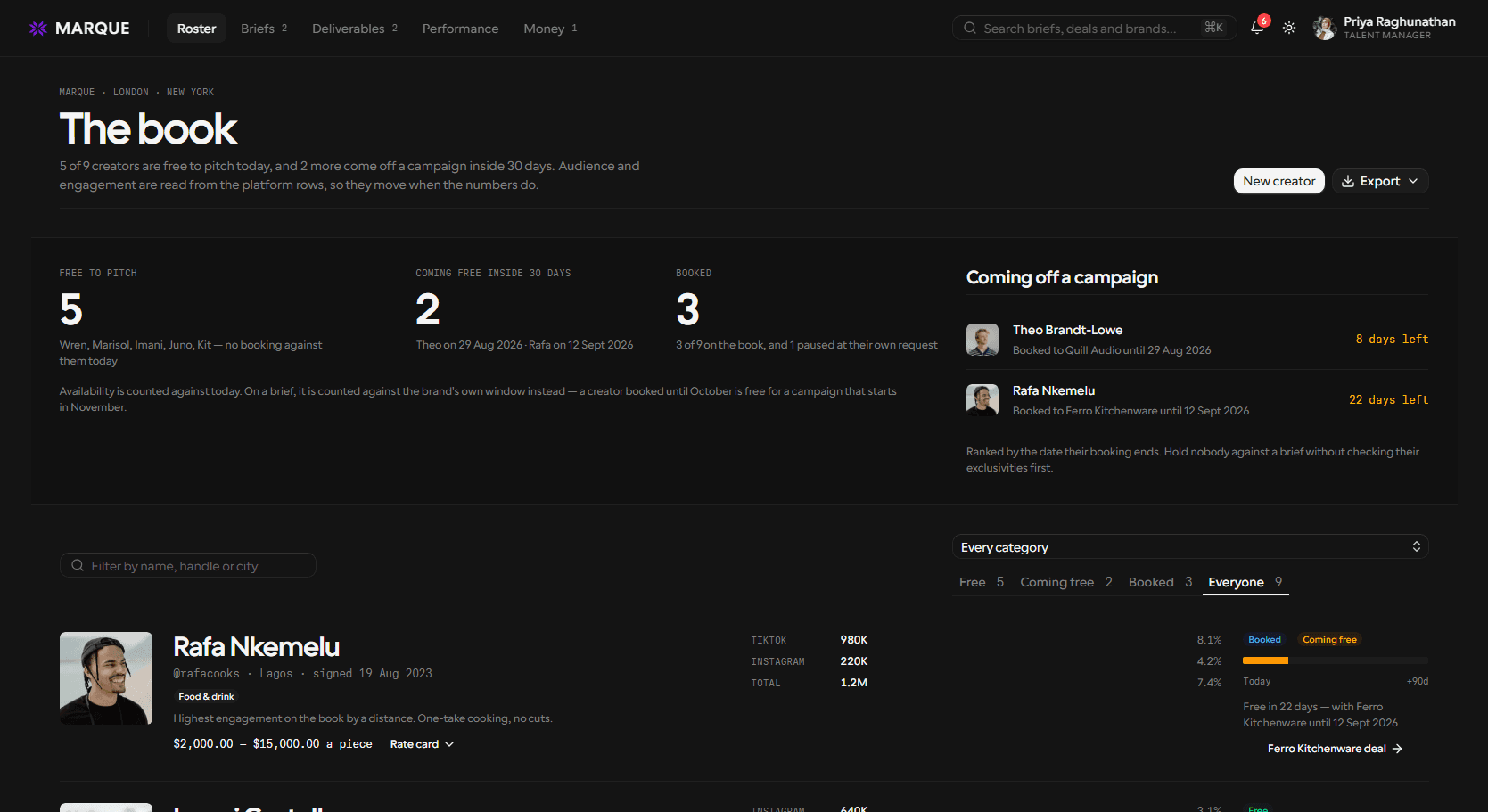
Two customers, and one desk between them.
A brand wants a campaign booked. A creator wants a career managed. The agency answers to both, and every screen in this product exists because that job needed it.
01The screens →Three figures over nine creators. Availability counts against today here and against the brand’s own window on a brief — so somebody booked until October is free for a campaign starting in November.
the same word, two clocks02BookA pitched brief becomes a deal, and the deal brings its deliverables, its invoice and its payout with it. The contract walks a declared line, dated at every step.
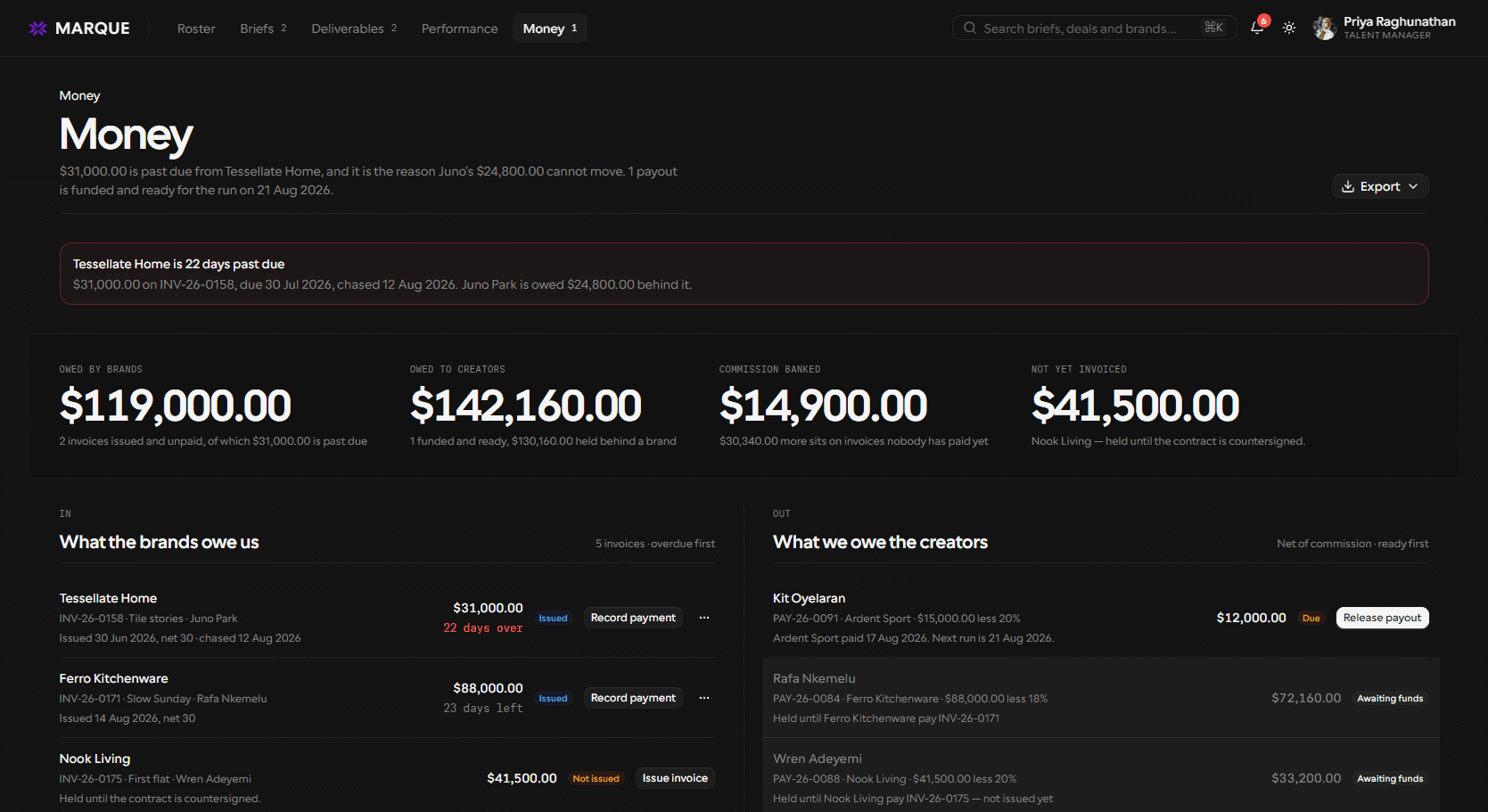
book the deal, not create deal03Collect$119,000.00 owed by brands against $142,160.00 owed to creators — and the commission banks when the money clears, not when the deal is signed.
$14,900.00 banked, not $45,240.00Each one answers a question the last one raised.
Twenty-eight registered routes: five destinations in the bar, fourteen off it, nine for auth. There is deliberately no deals list and no brands list — a deal or a brand is only ever reached through the work that names it.
02The status sets →A face business, led by a face
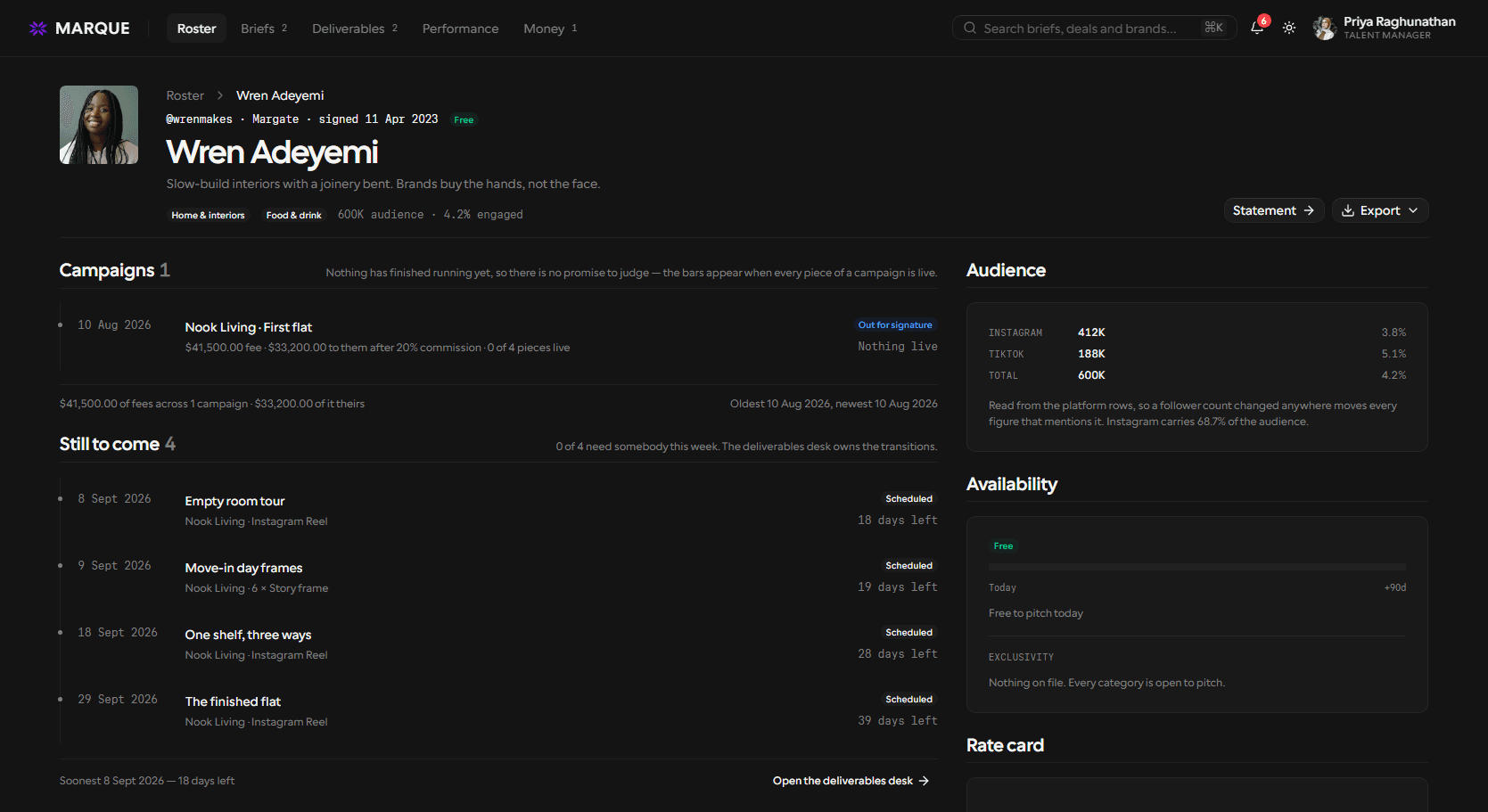
The record opens on the creator’s portrait, because that is what this industry trades on. The 600K audience beneath it is not stored — it is 412K on one platform and 188K on another, added up in front of you, and the panel says so: a follower count changed anywhere moves every figure that mentions her.
- 3.8% and 5.1% weighted into the 4.2% on the header
- Instagram carries 68.7% of the audience, and that is derived too
- Nothing has finished running, so there is no promise to judge yet
The honest answer is no
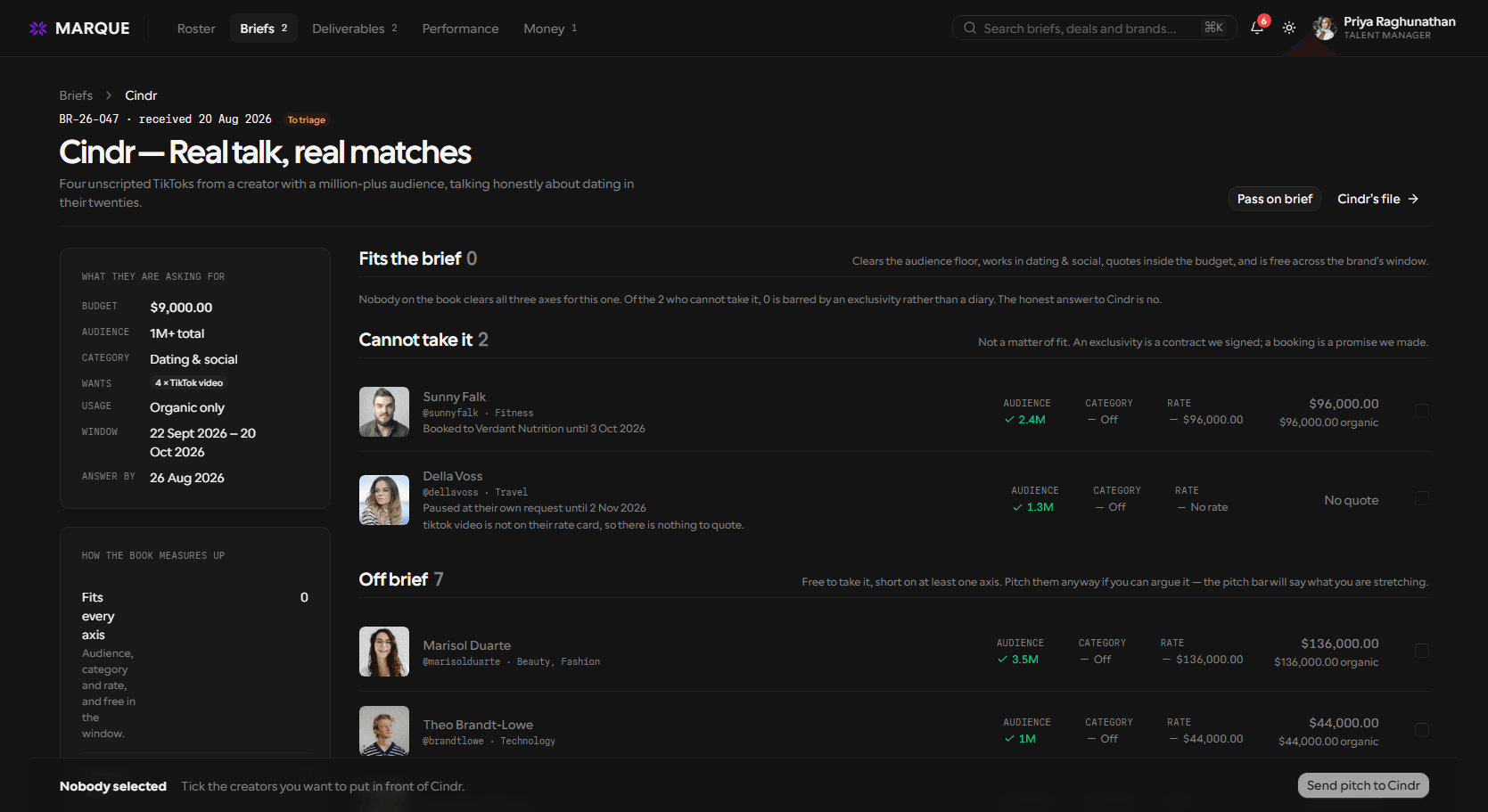
A brief wants four TikToks from a million-plus audience in dating and social, organic only, answered by the 26th. Nobody on the book clears all three axes. The screen leads with that — fits the brief, zero — rather than padding the list with the closest thing to a yes.
- Cannot take it and off brief are different groups, and say why
- “An exclusivity is a contract we signed; a booking is a promise we made”
- One creator has no rate for the format, so there is nothing to quote
One deal, and the five records it binds
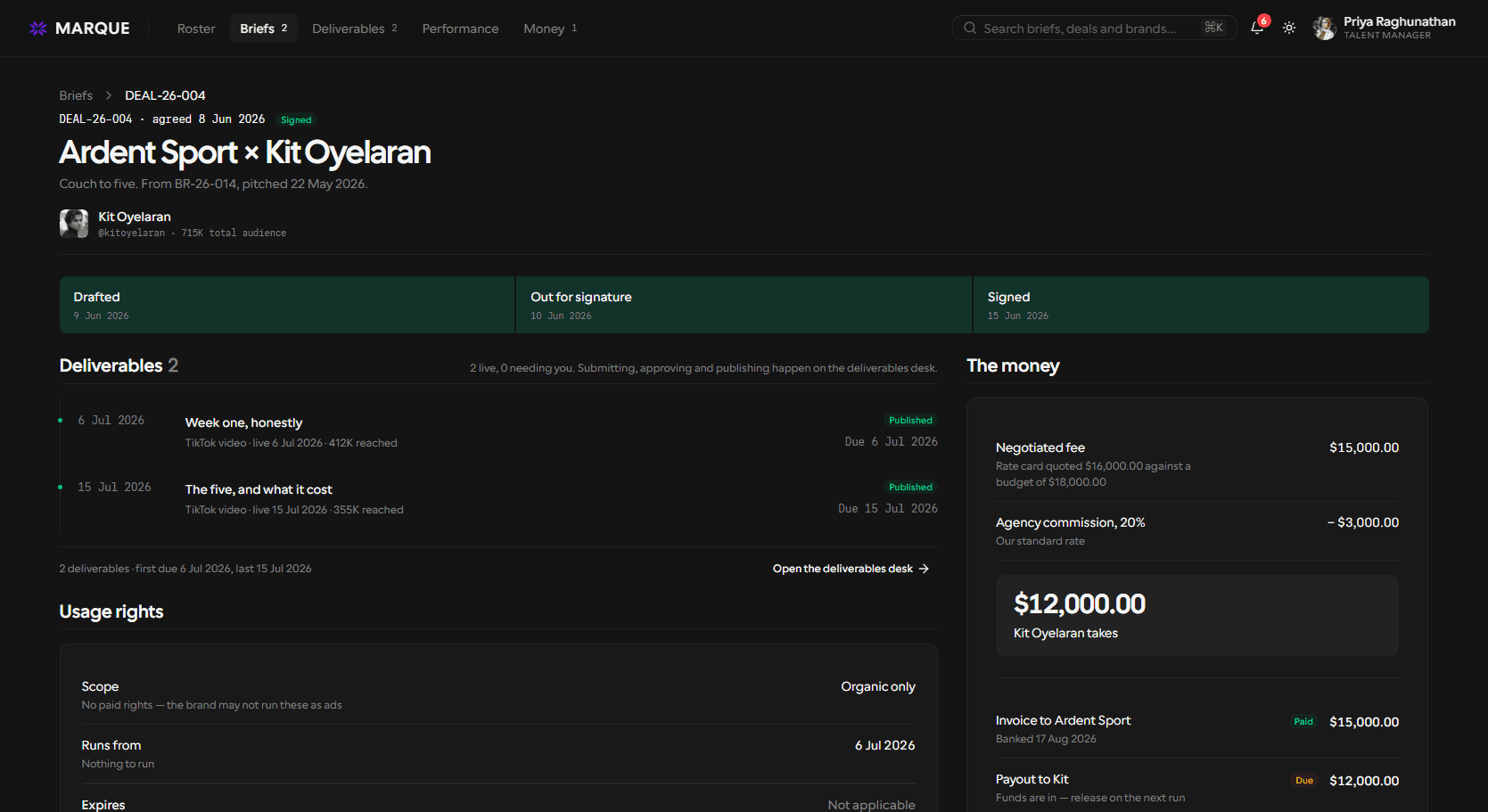
A fee of $15,000.00 against a rate card that quoted $16,000.00 and a budget that allowed $18,000.00 — the negotiation is on the page, not behind it. Deliverables, invoice and payout all hang off this record because none of the three can be created without it.
- Drafted, out for signature, signed — each with the date it landed
- Organic only: the brand may not run these as ads
- The invoice is paid and the payout is due, on two separate clocks
Two ledgers facing each other
What the brands owe us on the left, what we owe the creators on the right. A creator’s $24,800.00 cannot move because a brand is 22 days past due on $31,000.00, and the header says exactly that rather than leaving a payout marked pending with no cause.
- Every held payout names the invoice holding it
- $41,500.00 uninvoiced, because that contract is not countersigned
- Commission banked excludes the invoices nobody has paid
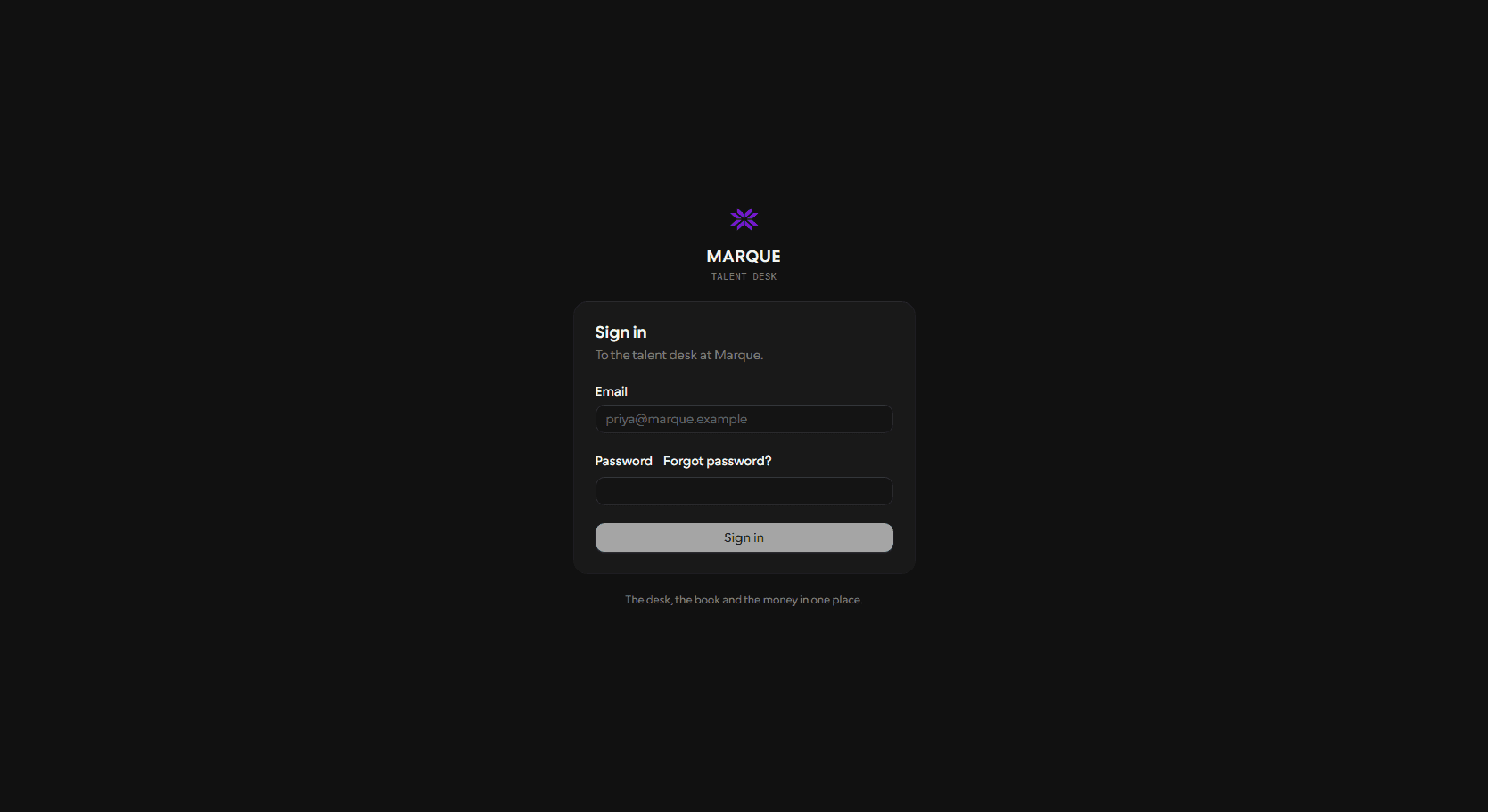
The screen with no navigation at all
Auth is a shell decision before it is a form: no nav owner, one layout variant, one credential strategy. Every route the screens offer exists behind them — five stages of recovery, the expired-link branch, and a sixth screen for the lockout that three failed attempts earns you.
- One line of copy under the card, and nothing else on the page
- The lockout counts down to “The wait is over” rather than a dead end
- Nine auth routes, none of them a link into nowhere
The states that hurt are the ones nobody can set.
Every value a record can hold is declared once and stored. Overdue is not among them on either side of the money — it is a predicate over a date, computed as the page draws, and it turns true at midnight without anyone touching the record. Rights expiring and rights lapsed work the same way.
03The awkward cases →The fixtures are deliberately unkind.
An industry that runs on remembered numbers hands you records that do not fit the shape a screen wants. These were in the set from the first pass.
04The derivation →Every figure, traced back.
The wrap report is the check: 767K reached against 700K promised, 109.6% of it. The two posts beneath the headline carry 412K and 355K, and 56.8K engagements and 7.2K saves split the same way. Every figure on the page is the sum of the rows under it, and each row is the platform’s own number entered when the post went live.
05Back to the top →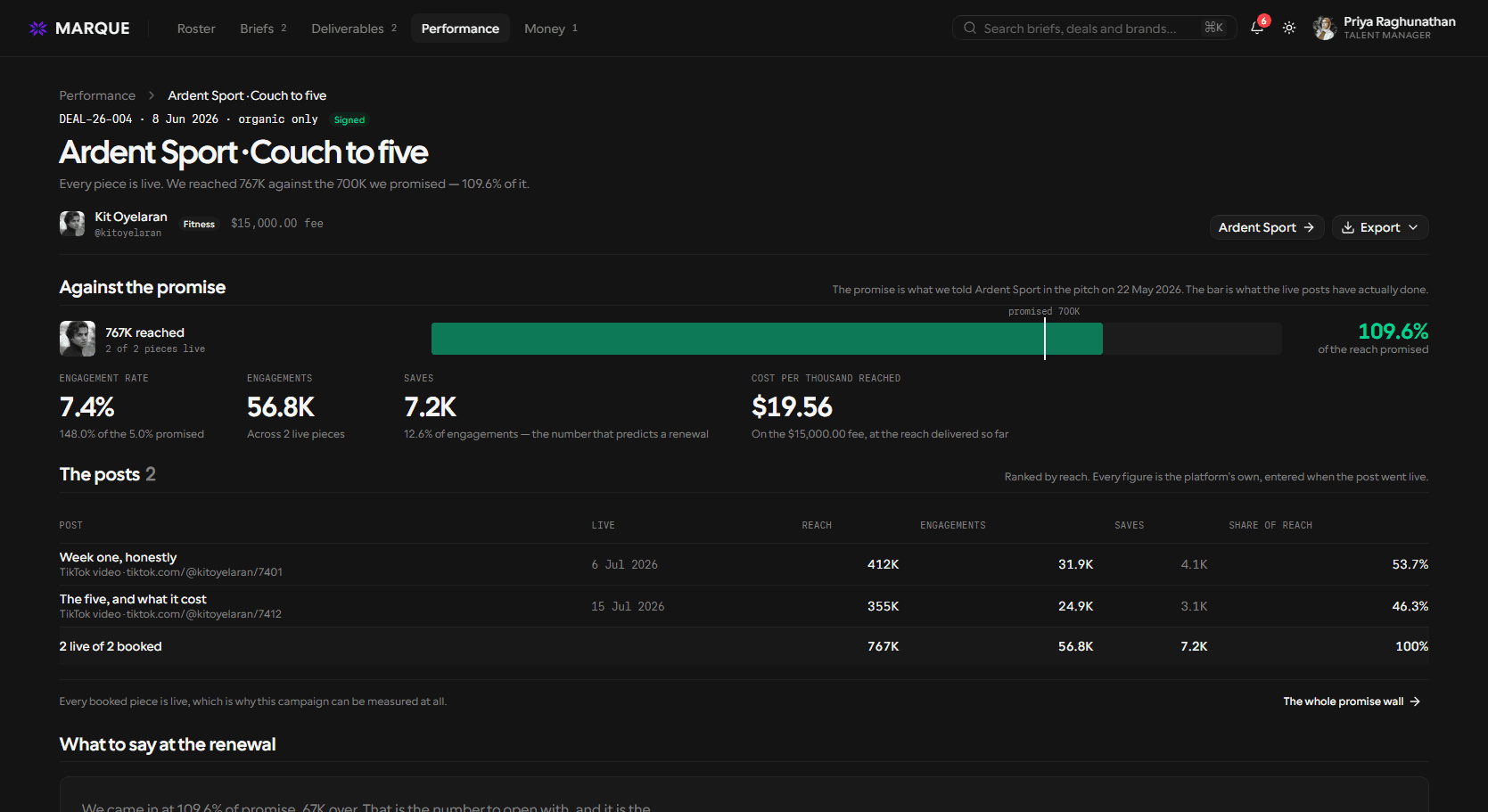
Reckon
The rules travel.
The product does not.
The distance between the two is the design work. Derive every number, declare how every entity commits, and refuse the creates that do not exist in the business.