Nothing here stores what a conversation costs.
A chat workspace for an eight-person team, with the context window, the cycle bill and the seat count all derived from the messages and the fixture arrays. Looking at it should settle whether an assistant product can show its own arithmetic without a single stored total.
Preview interactive design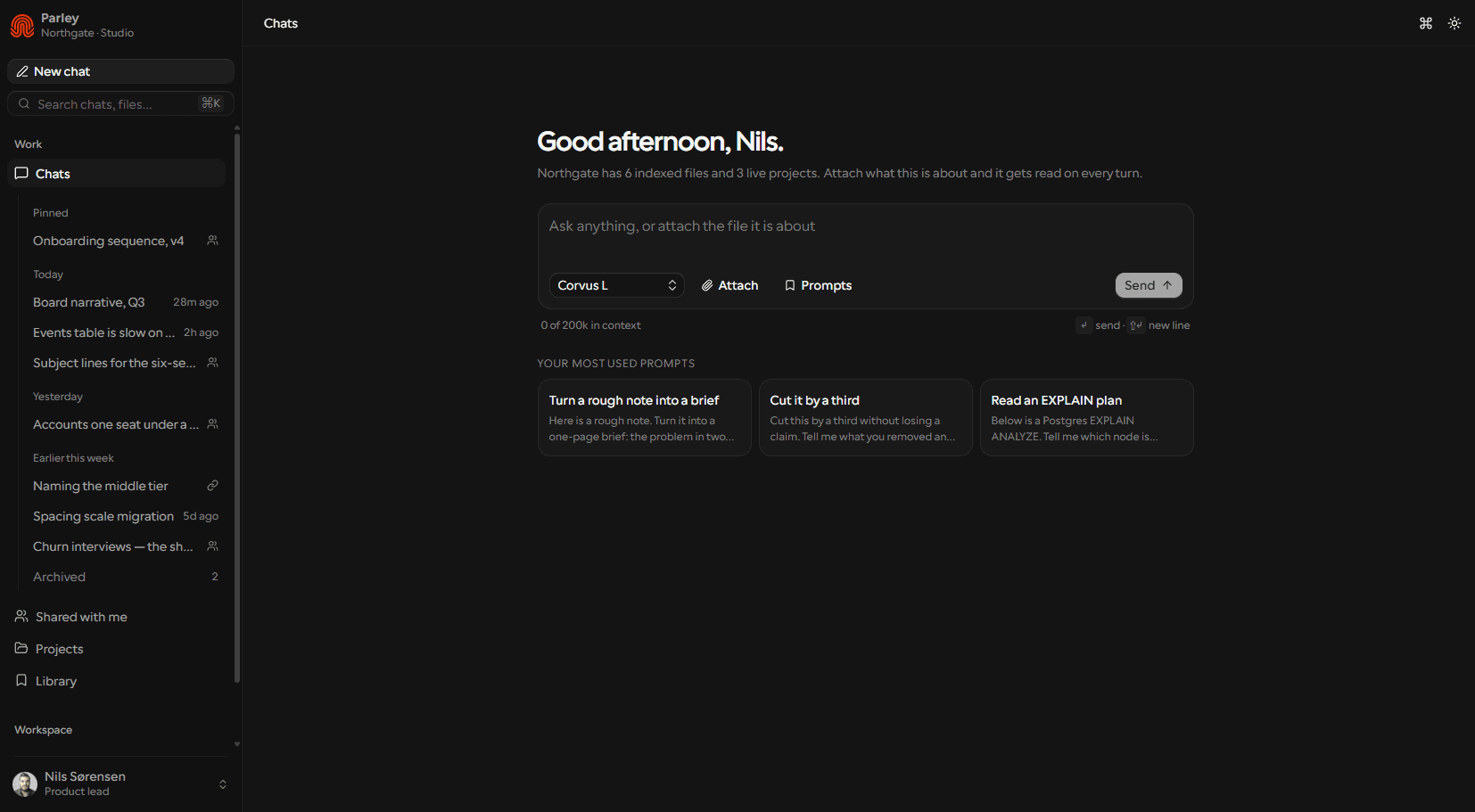
Read the answer, then pay for it.
A product lead runs the week’s writing, code review and research through one assistant, on a workspace allowance that resets on the first. Every turn re-reads the conversation, so a reply costs what is already in the window.
01The screens →A thread carries the files it is reading, and only a file the index actually read reaches the window. One that failed or is unsupported carries nothing and is left out of the meter.
nothing stored, counted per render02SendA turn is billed for the context that existed when it ran plus what it wrote, so the same question costs more late in a thread than early. Output bills at five times input.
a failed turn is absent, not zero03ReconcileThe usage screen, the thread’s own cost and the cycle charge are three views of one set of turns. Nothing writes a total — sending a message moves all three at once.
one array, three screens, no cacheFive screens, one set of turns.
Twenty-one registered routes: six sidebar destinations, six off it, four settings and five auth. There is deliberately no list screen for turns — a turn is only ever reached through the thread that holds it.
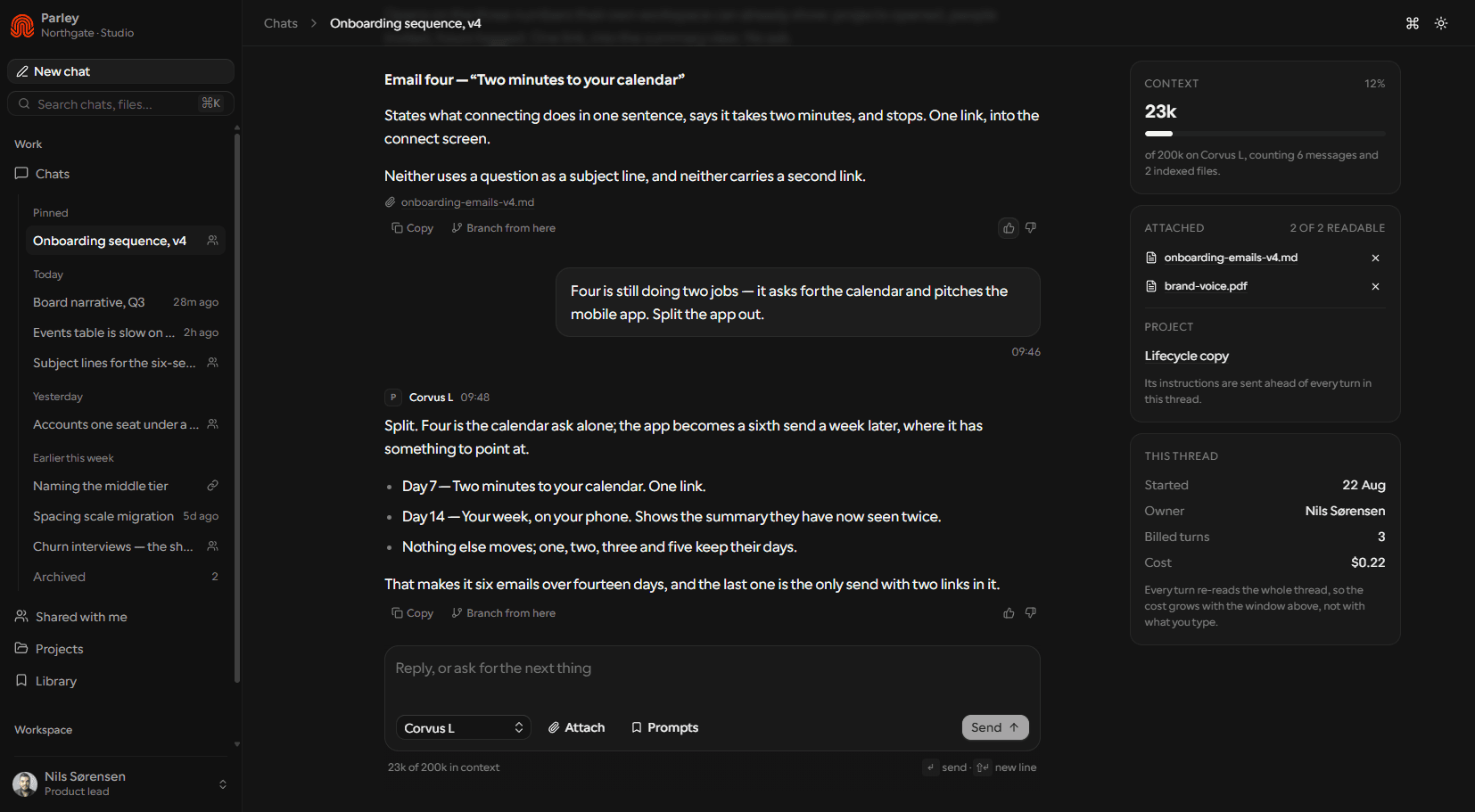
02The status set →The conversation, with what it is reading beside it
The thread owes an answer for how full the window is and what the reply was based on. It shows the cited files under each turn, and refuses to imply a file is in context when the index could not read it.
- 23k of 200k, counting six messages and two indexed files
- The files cited are named under the turn that cited them
- Three billed turns and $0.22, stated on the thread itself
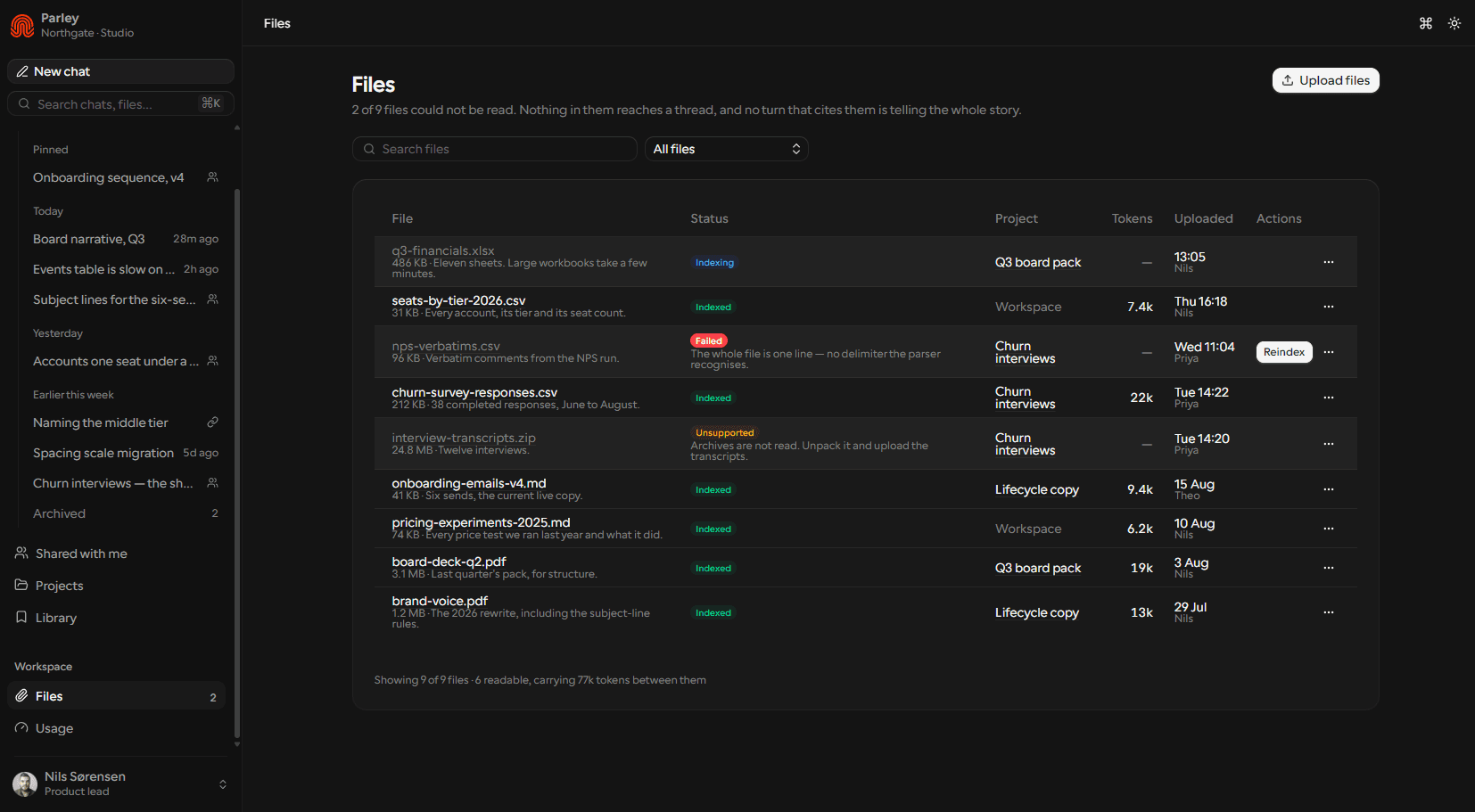
Files, and the two the index could not read
The index is the honest part of an assistant product. Every row says whether the model can read the file, and a row that cannot carries the reason and the one move that helps. Nothing falls back to a zero token count.
- “2 of 9 files could not be read”, in the screen’s own lede
- Six readable files carrying 77k tokens between them
- The failed row offers Reindex; the archive is told to be unpacked instead
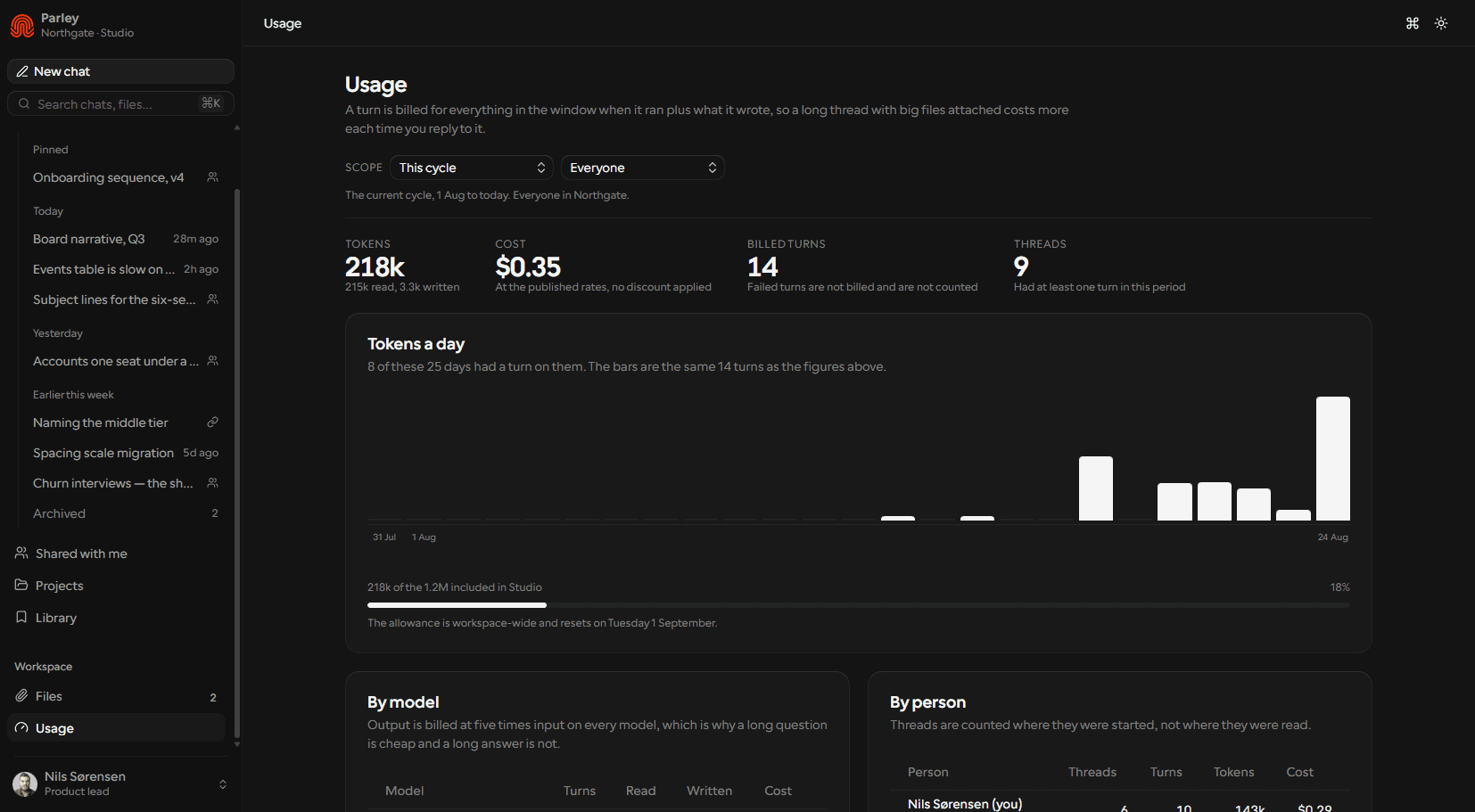
What the week’s turns actually cost
The day chart, the model table and the person table are the same fourteen turns grouped three ways, so no two of them can disagree. It declines to chart a day with no turn on it as a zero.
- 218k tokens, $0.35, 14 billed turns across 9 threads
- 218k of the 1.2M included in the plan — 18%
- 8 of the 25 days had a turn on them, and the bars are those same 14
Seats, and the difference between paying and using
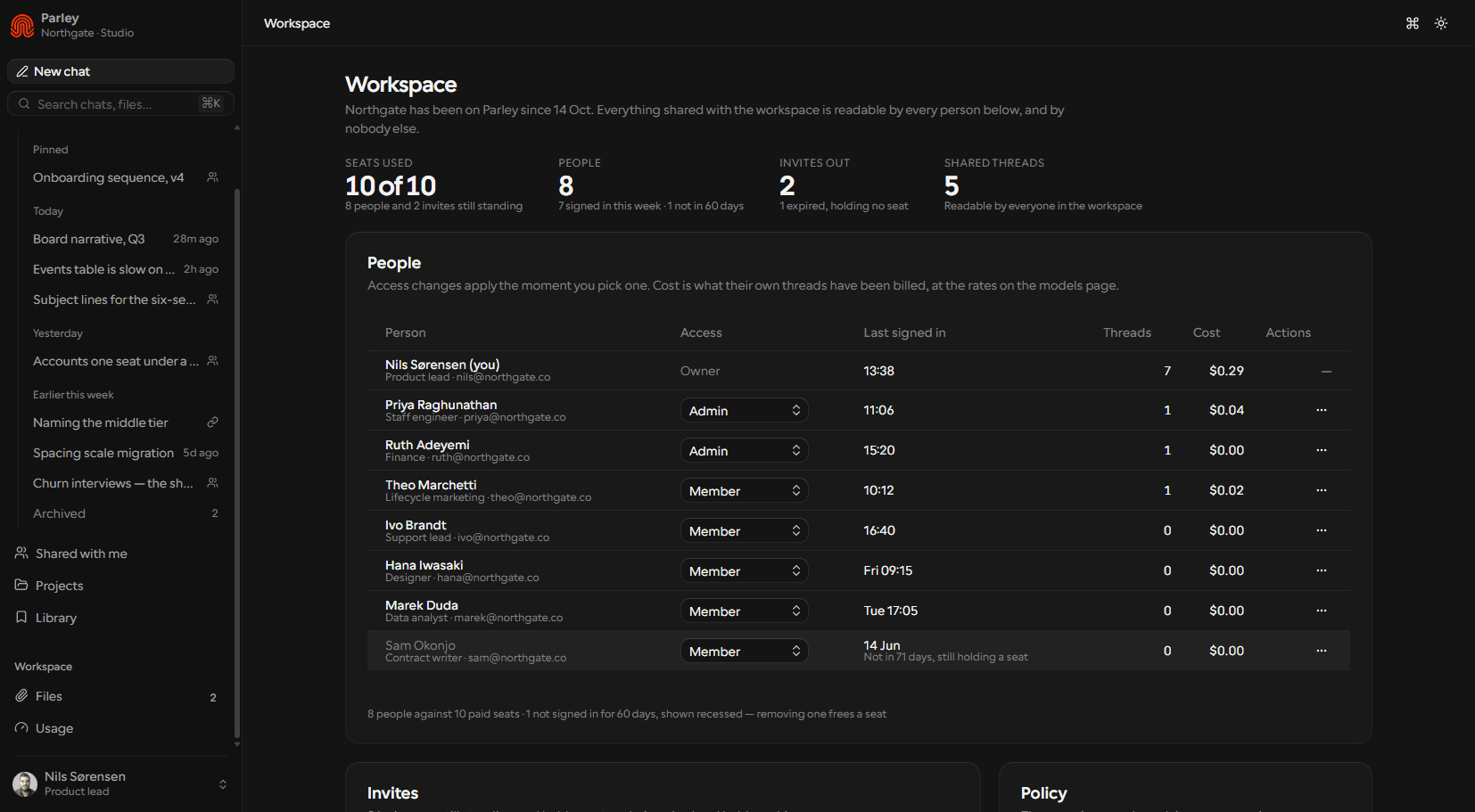
A seat is held by a person or by an invite still standing, so the figure is people plus unexpired invites and never a stored count. A dormant member is recessed with the reason rather than disabled or hidden.
- 10 of 10 seats used — eight people and two invites still standing
- One expired invite, holding no seat
- “Not in 71 days, still holding a seat” on the dormant row
The bill, including the one that did not go through
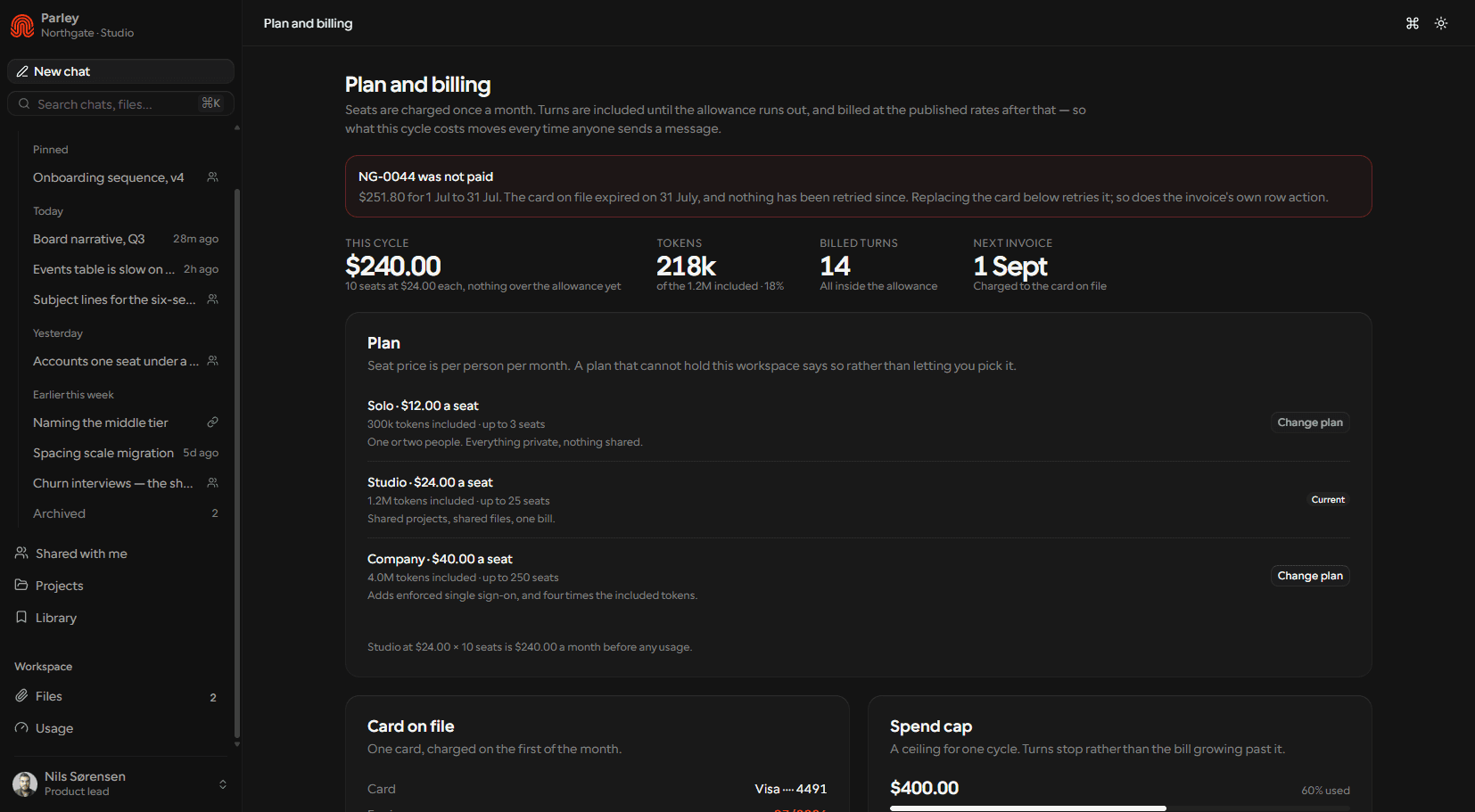
The current cycle has never been invoiced, so it is derived from the same turns the usage screen charts. The failed invoice is not a badge on its own — it carries the reason it failed and the thing that fixes it.
- $240.00 this cycle — ten seats at $24.00, nothing over the allowance yet
- One invoice unpaid: $251.80, for the month before
- A $400.00 spend cap, 60% used, seats included
Three of the four things you would look for are missing.
Four vocabularies over five fields, and none of them holds what an assistant product is expected to store: whether a thread is near its context limit, whether a prompt has gone stale, whether an invite still holds a seat, whether a card has expired. All four are computed at render.
03The awkward cases →The fixtures were written to be difficult.
Each of these is a real record in the fixture, and each one is the reason a figure on some other screen is derived rather than stored.
04The audit →The arithmetic held; the chrome did not.
Every derived figure was walked against the array under it and none disagreed — fourteen billed turns reconcile across the usage table, the person table and the cycle charge, and ten of ten seats reconciles with eight people and two standing invites. What the pass changed was interface: the composer carried a duplicated focus treatment, and the brand mark was sized by an inline style on one screen and by a rule everywhere else.
05Back to the top →
Reckon
The meter is portable.
The domain is not.
Threads, files and seats are this template’s nouns, but the rule underneath travels: if a screen shows a total, the array that makes it is on the same page.