One process, and every clock derived from it.
A recruitment desk for a 4,100-person health group: nine destinations over one application record, where the stepper is the same component on the queue, the board and the record. What it settles is whether a hiring product can hold a gate without inventing a status for it.
Preview interactive design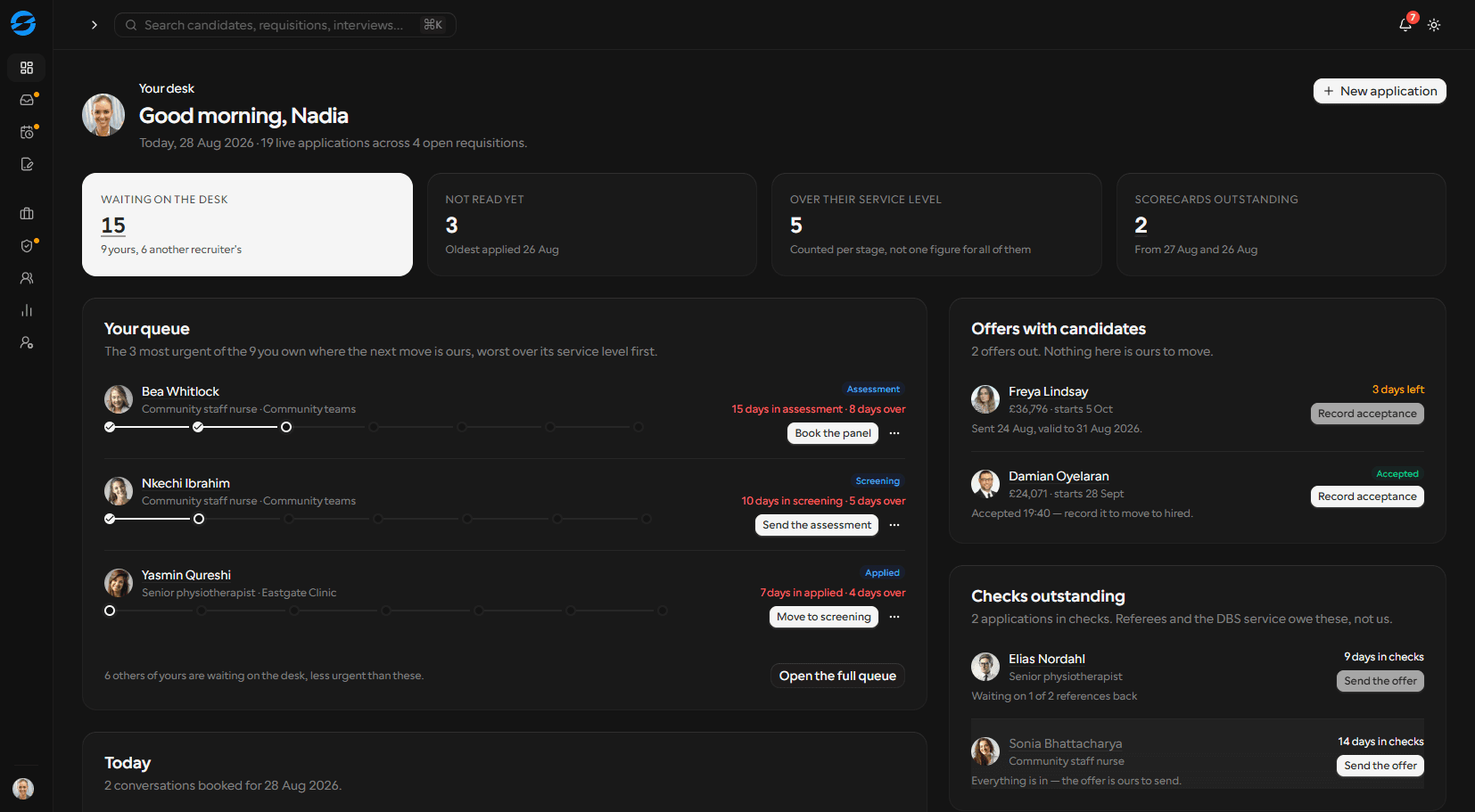
Read it, score it, prove it.
A recruiter carries two seats’ worth of pipeline and a hiring manager who wants a start date. The constraint that shapes every screen is the pre-employment gate: two references, a verified right to work, and the register the seat asks for still in date — or nobody starts.
01The screens →Three of the five at applied have never been opened. Every row is judged against its own stage’s allowance, so a day at applied is later than a week at checks.
unread is the absence of a timestamp02ScoreA panel decision needs two scorecards from two different people. One card is not a decision, so the move to checks is offered, disabled, and states the count it is still waiting on.
the average is never stored03ProveNothing reaches offer until the checks are back. Which register a seat asks for is the requisition’s business rather than the candidate’s — so a ward clerk owes none, and the screen shows no gap.
a check nobody owes is absent, not failedNine destinations over one record.
Twenty-three registered routes: nine sidebar destinations, twelve off the nav, two for auth. Neither an interview nor an offer has a record route — an interview is a row and a dialog, and an offer is a field on the application it belongs to.
02The status set →What is waiting, and whose it is
The queue promises a number the sidebar badge also shows, so both call one act-ability predicate over one array. The order is how far over its own stage’s allowance a row is, and the date it arrived only breaks ties.
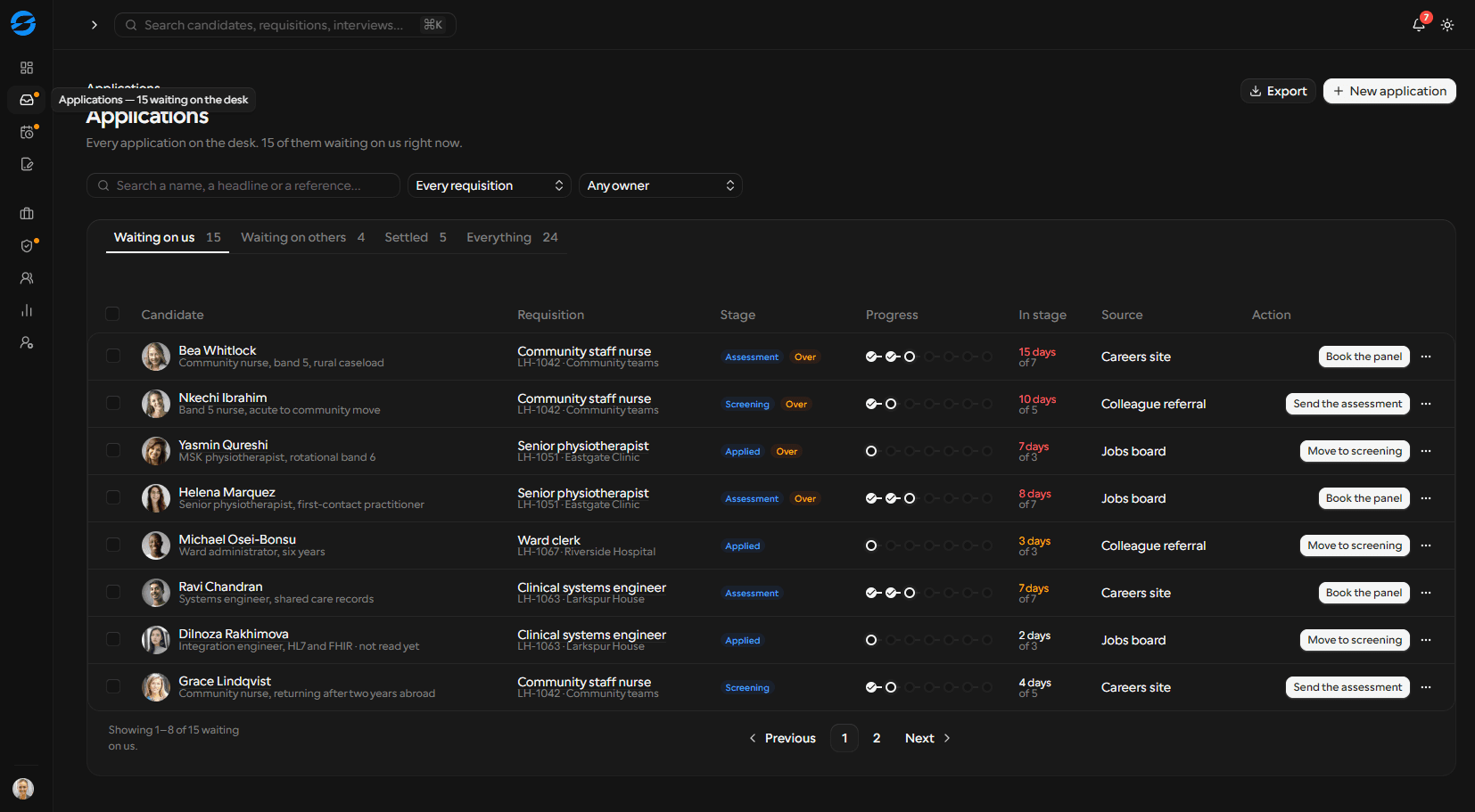
- “Every application on the desk. 15 of them waiting on us right now.”
- Waiting on us 15 · Waiting on others 4 · Settled 5 · Everything 24
- Ordered by how far over its own stage’s allowance a row is, never by arrival
The application, and what the next move waits on
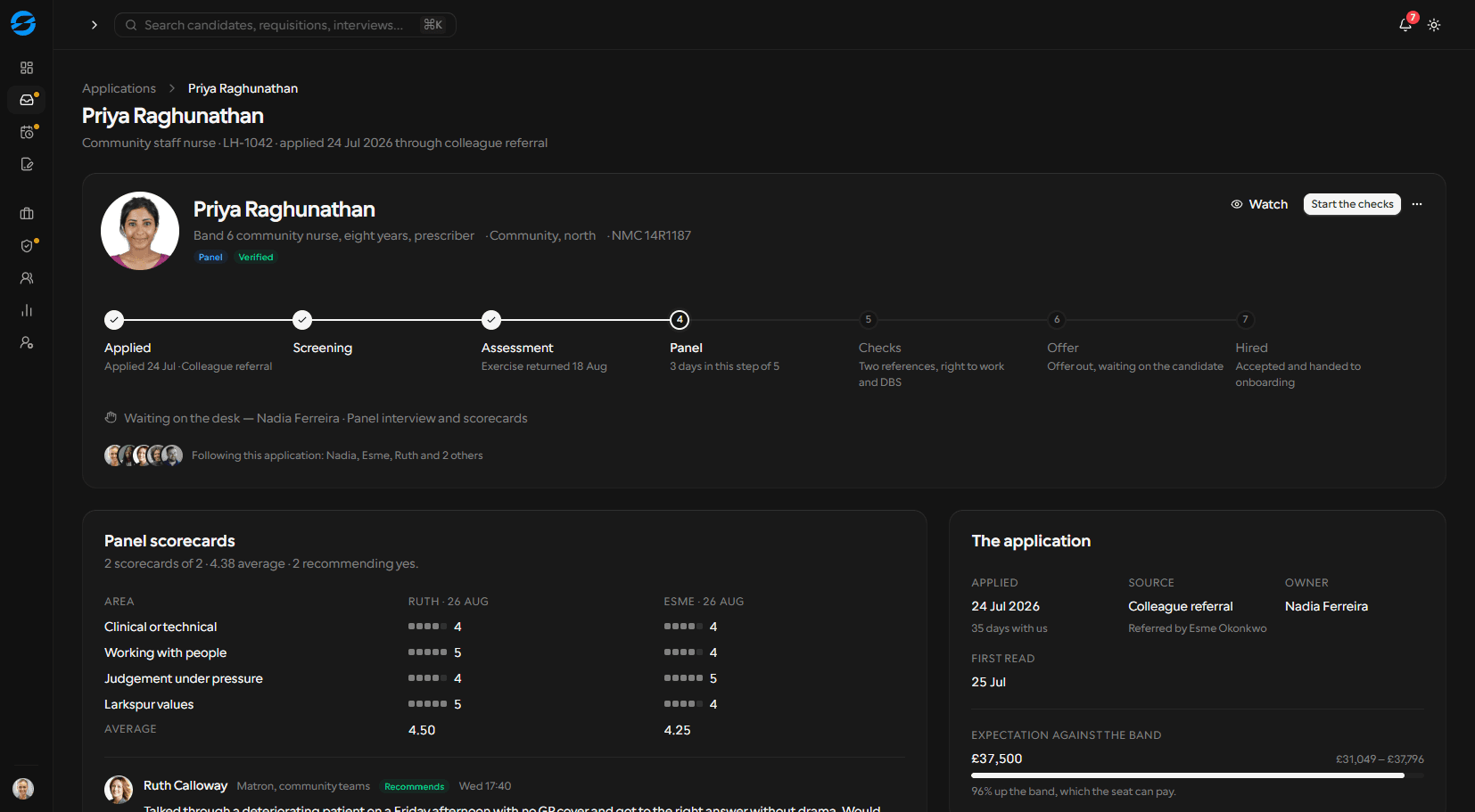
One record for one person, reached from the desk, the queue, the ladder and the board alike. The stepper is the spine: a completed step cites the sub-record that completed it, and a step with nothing to cite says what it is for.
- “2 scorecards of 2 · 4.38 average · 2 recommending yes” — Priya Raghunathan
- Checks: “0 of 2 references back · right to work verified · DBS with the service”
- Seven steps on the strip of nine declared values — declined and withdrawn are ends
What runs out first
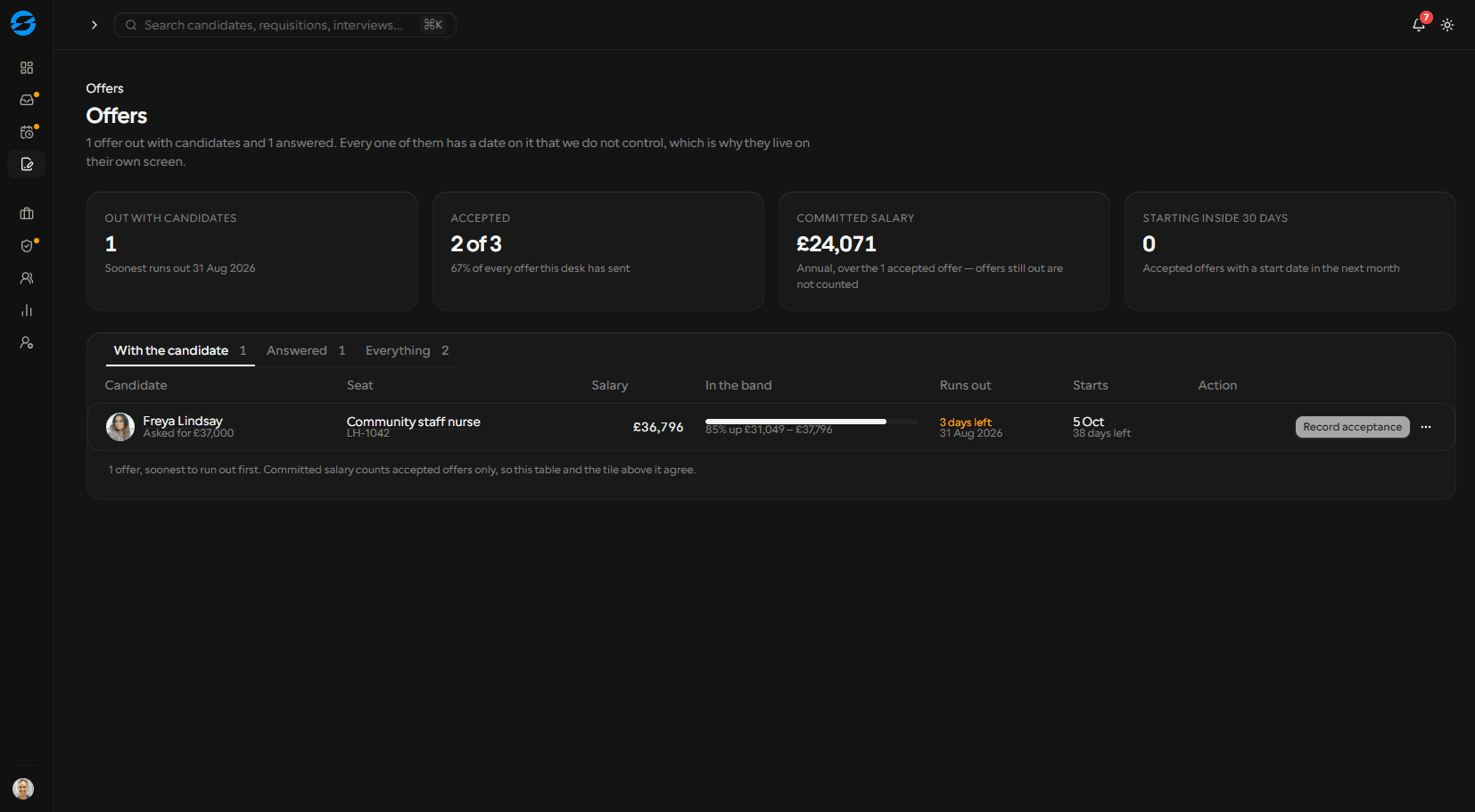
Two offers, ordered by expiry rather than by value. Each row says where the salary sits in the band it came from, and names what the candidate asked for where the offer came in under it. It will not record a hire nobody has accepted.
- £36,796 to Freya Lindsay — 85% up £31,049 – £37,796, 3 days left
- “Asked for £37,000” sits under the row where the offer came in under it
- Accepted 2 of 3 · 67% of every offer this desk has sent
The three things that must be true before anybody starts
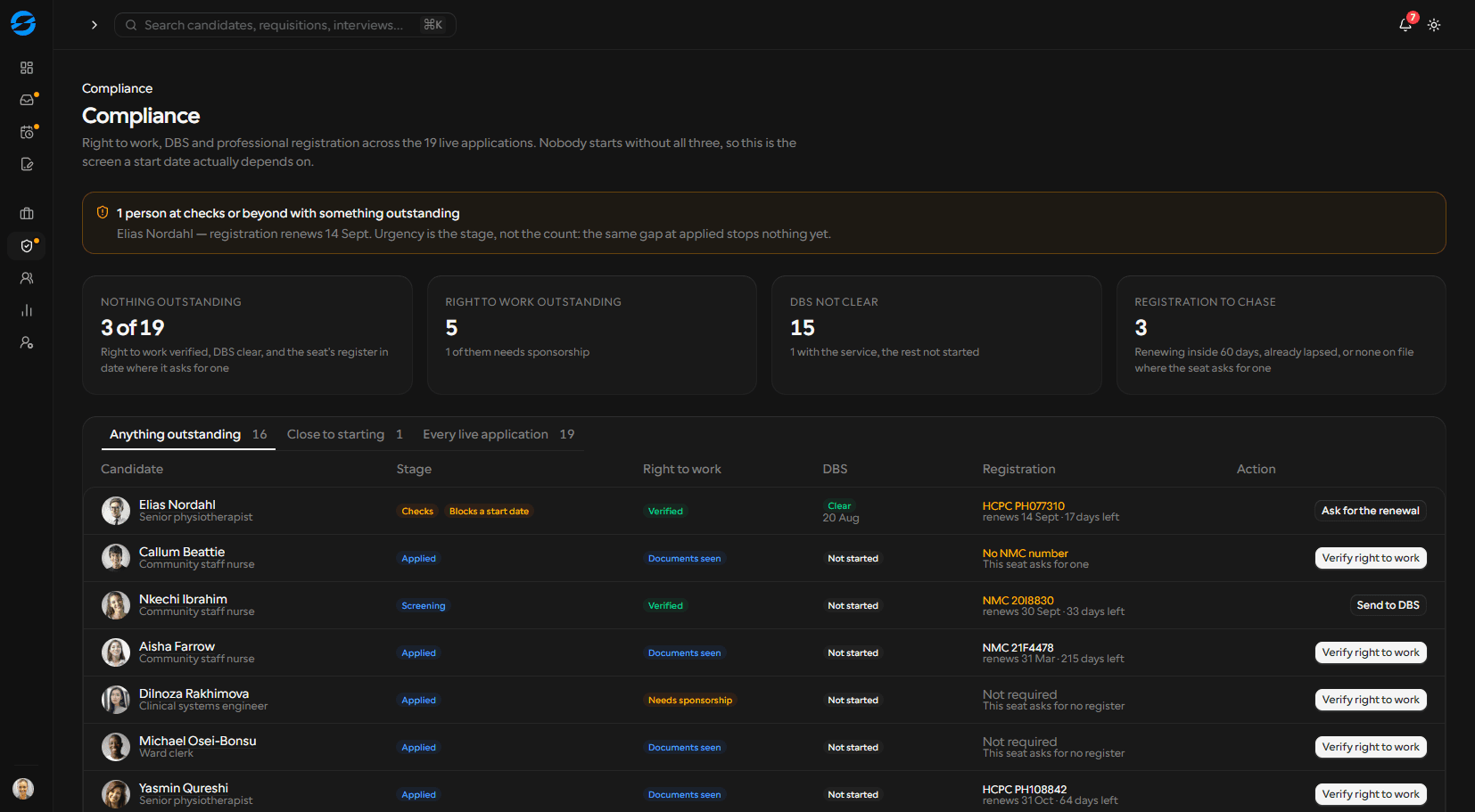
One row per live application, three checks each, urgent first — a blocker at offer stops something, the same blocker at applied stops nothing yet. Urgency is the stage, never the count, and the row with the live action on it is never greyed out.
- 16 with something outstanding, 3 with nothing, 1 close enough to a start date to matter
- “renews 14 Sept · 17 days left” against Elias Nordahl, the one row at checks with a gap
- Callum Beattie’s register cell: “No NMC number · This seat asks for one”
One seat, its pipeline and the advert that filled it
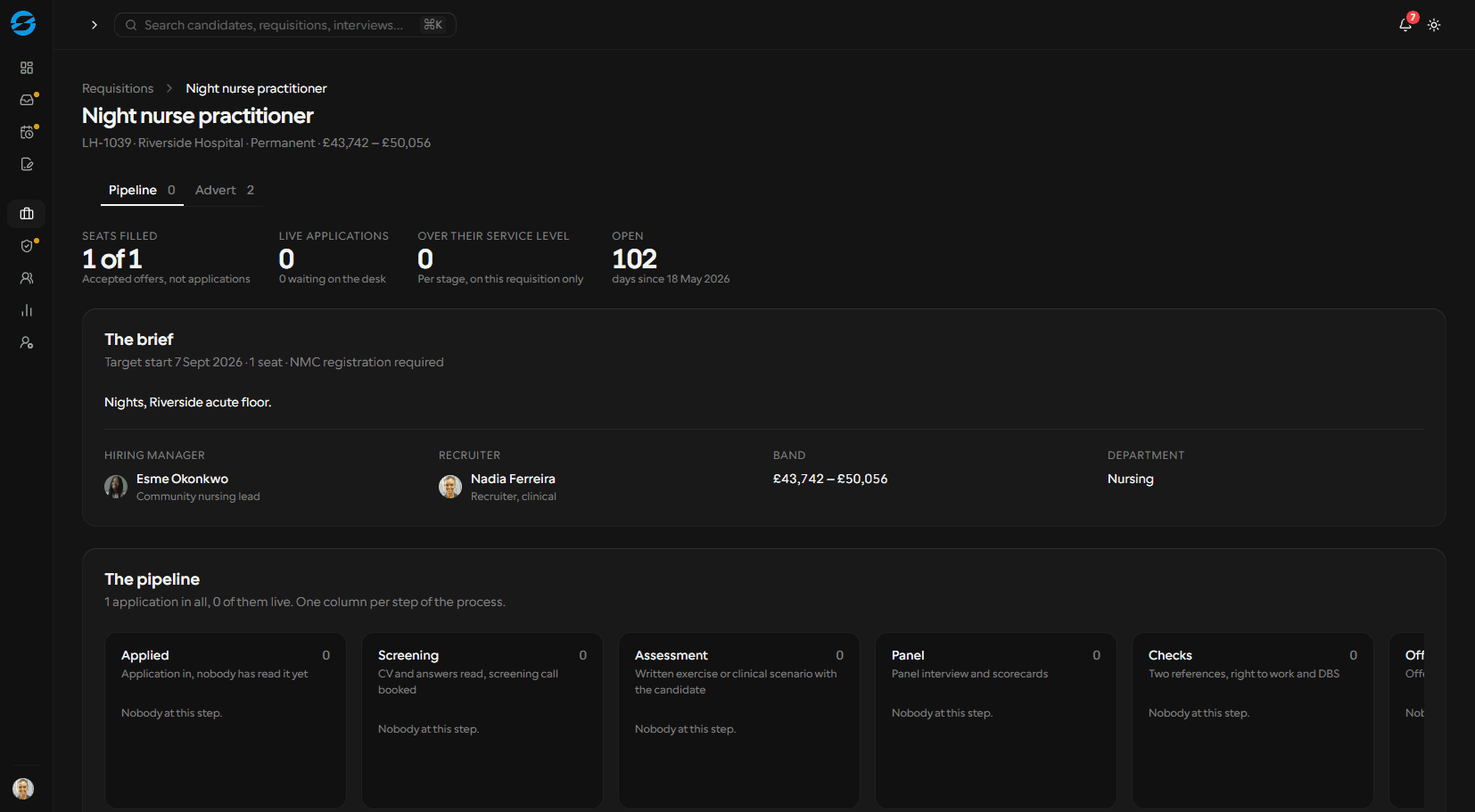
A requisition is seats, not a hire: three nurse seats, nine live applications, none accepted. It holds which register the seat requires, and the advert tab counts what each channel actually produced rather than quietly folding in the rest.
- LH-1042 — 3 seats, 9 live, 59 days open, aging past 45, NMC registration required
- 4,546 views, 7 applications, 0.2% — best channel Careers event at 1.0%
- 3 more arrived another way — a referral, the pool, an event
Nine values, and four clocks that are not among them.
The value everybody looks for here is stalled, and it is not in the set. Lateness is days in the current stage against that stage’s own allowance, computed at render — as are unread, offer expiring and registration outstanding. A record carries one stage and any number of derived flags.
03The awkward cases →Where the gate has to hold.
Each of these is a record in the fixture, reachable in the running template.
04The audit →Two predicates where there should have been one.
Recession was keyed on “clear to start” while urgency was keyed on “has a blocker”, and one record satisfied both: a registration in date today, renewing in seventeen days. The only row the badge counted was styled as work nobody can act on. Clear to start is now the plain negation of the three outstanding flags.
05Back to the top →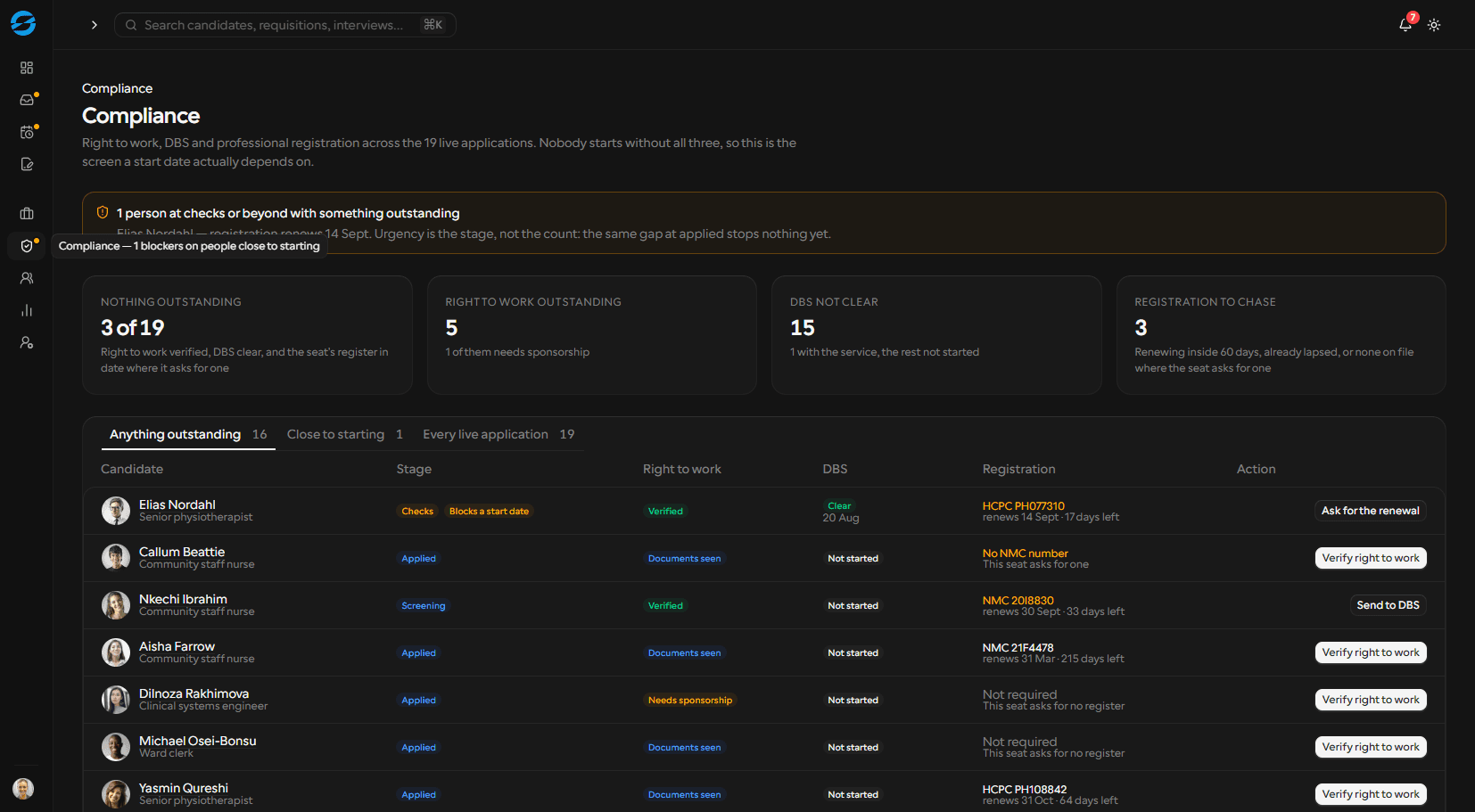
Reckon
The process is one.
The seats are not.
One hiring process from ward clerk to systems engineer, with the gate in the same place on every one. What differs is the register, the band and who sits on the panel.