The house is a set of derivations, not a dashboard.
Ten destinations over a household of five, where the temperature the house is holding, whether it counts as shut, and whether a filter is due are all worked out at render. Looking at it should settle whether a domestic product can be built on rules instead of switches.
Preview interactive design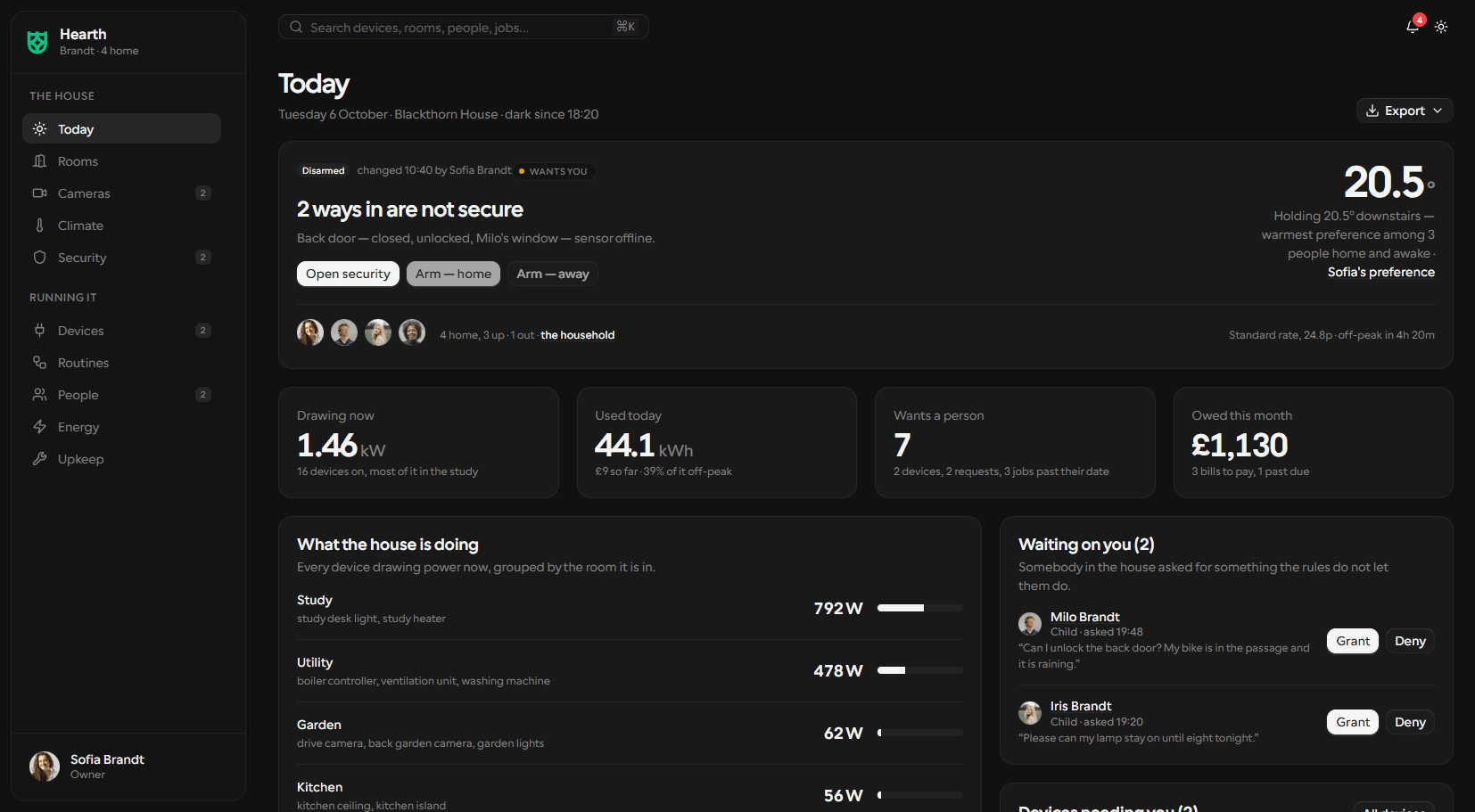
Nobody is on duty, so the house has to be.
The operator is a parent with a coat on. The constraint is that no state in a house is stable for more than an hour — people arrive, go to bed, open windows — so any figure the product stores goes stale between one glance and the next.
01The screens →The house states one verdict before anything else. An entry is scored insecure against the alarm and the clock: a window open at four is ventilation, the same window armed away is why the alarm exists.
the dark hour is a setting, not a constant02ControlRooms and cameras are the control surface: a switch means it applied. A move applies at once and offers the way back — only removing a device or calling the response company asks first.
a child sees the reason, not a grey button03KeepThe kit and the building rot on their own schedules. A consumable’s due date is the hours its machine has actually run, and a device becomes a problem the moment its radio reading changes.
the machine’s hours are the due dateEach screen owes an answer the last one raised.
Thirty registered routes: ten sidebar destinations over two groups, four registers reached from their parent, four records, the profile, seven under settings and six for auth. There is deliberately no /rooms/:id and no /cameras/:id — Rooms holds every room at once, and a camera has no fact a card cannot carry.
02The status set →The house in one card, before anything is a list
Today owes one answer — can the house be left alone — and gives it in a sentence, with a dotted badge for the attention level. Nothing is summed without its parts named underneath.
- “2 ways in are not secure” — the back door closed but unlocked, Milo’s window sensor offline
- Holding 20.5° downstairs — the warmest preference among the three people home and awake
- “Wants a person 7 — 2 devices, 2 requests, 3 jobs past their date”
Every room and its controls at once
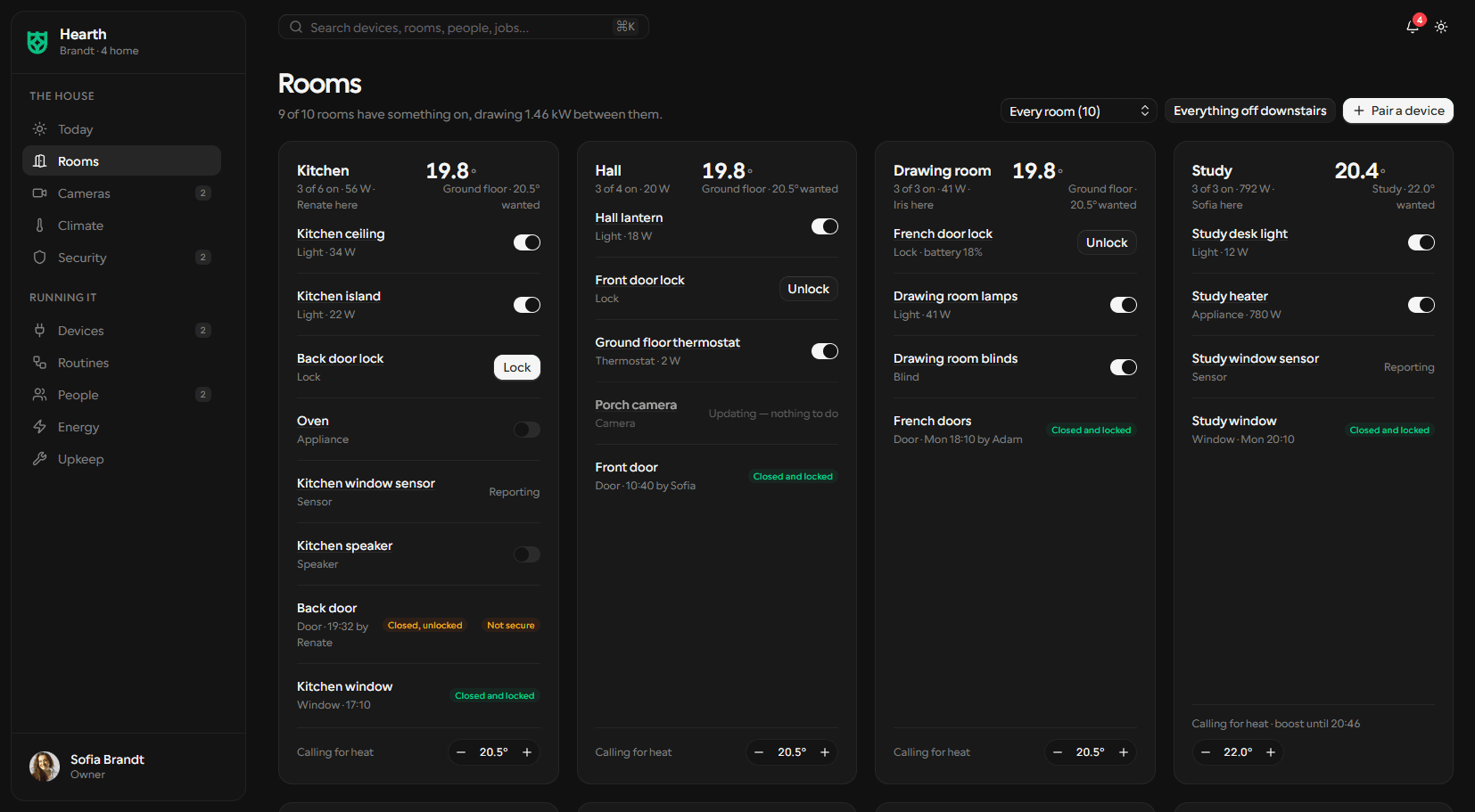
The room card is the remote control: a switch per device, the zone’s temperature, who is in there, what is insecure. There is no room record to open, because a room has nothing a card cannot carry.
- “9 of 10 rooms have something on, drawing 1.46 kW between them”
- “Everything off downstairs” acts on the lit lights it can name, and on nothing else
- “Porch camera · Updating — nothing to do”, recessed rather than greyed out
The live view first, and the shutters as a household decision
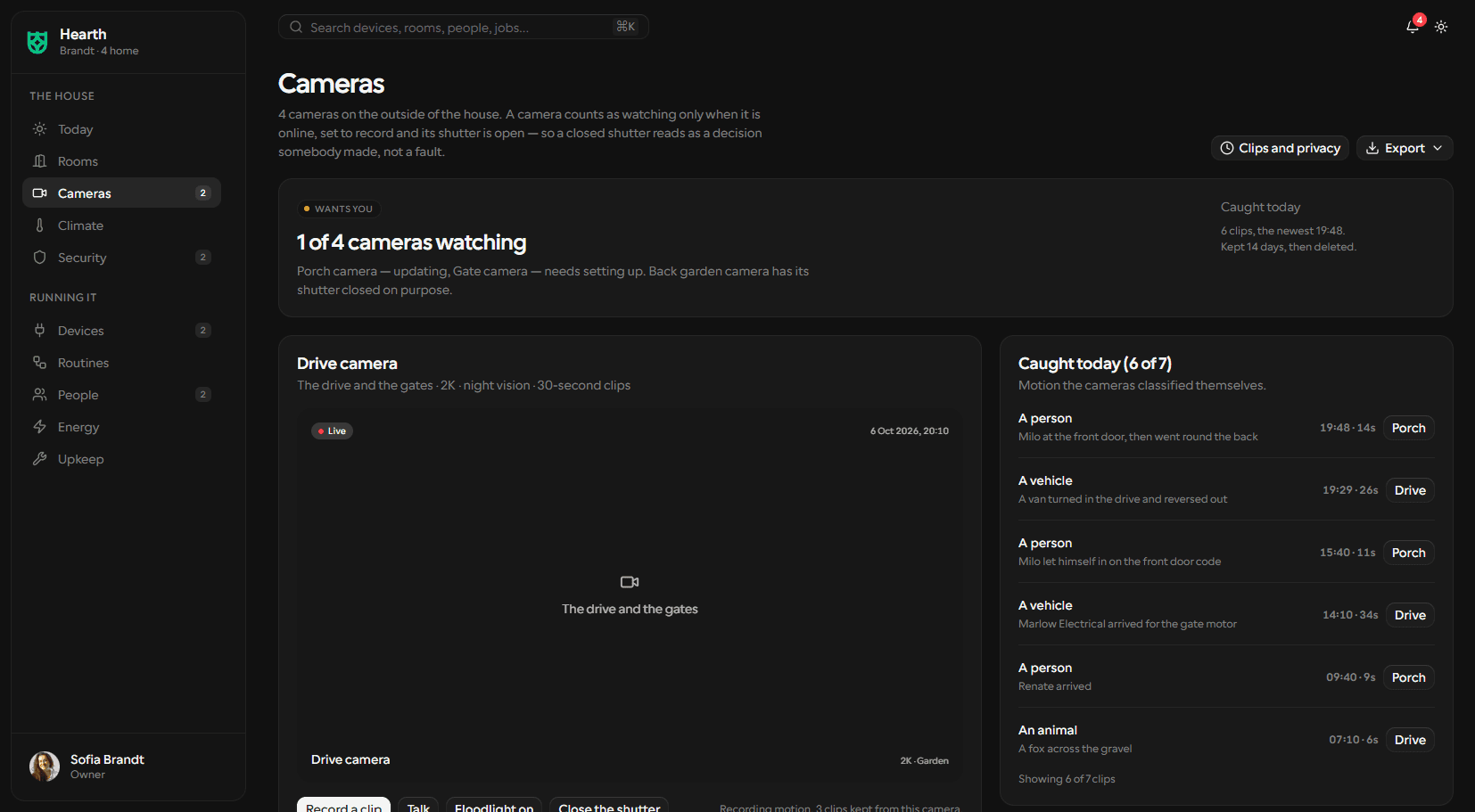
One camera focused with its controls, the others as tiles. Watching is three facts at once — online, set to record, shutter open — so a closed shutter reads as a decision somebody made.
- “1 of 4 cameras watching” — porch updating, gate never set up, back garden shuttered on purpose
- 6 clips today of 7 kept, the newest 19:48, deleted after 14 days
- Record, talk, floodlight, shutter — the controls are real, and the plate names what the camera is pointed at
The screen you open when the kit is wrong
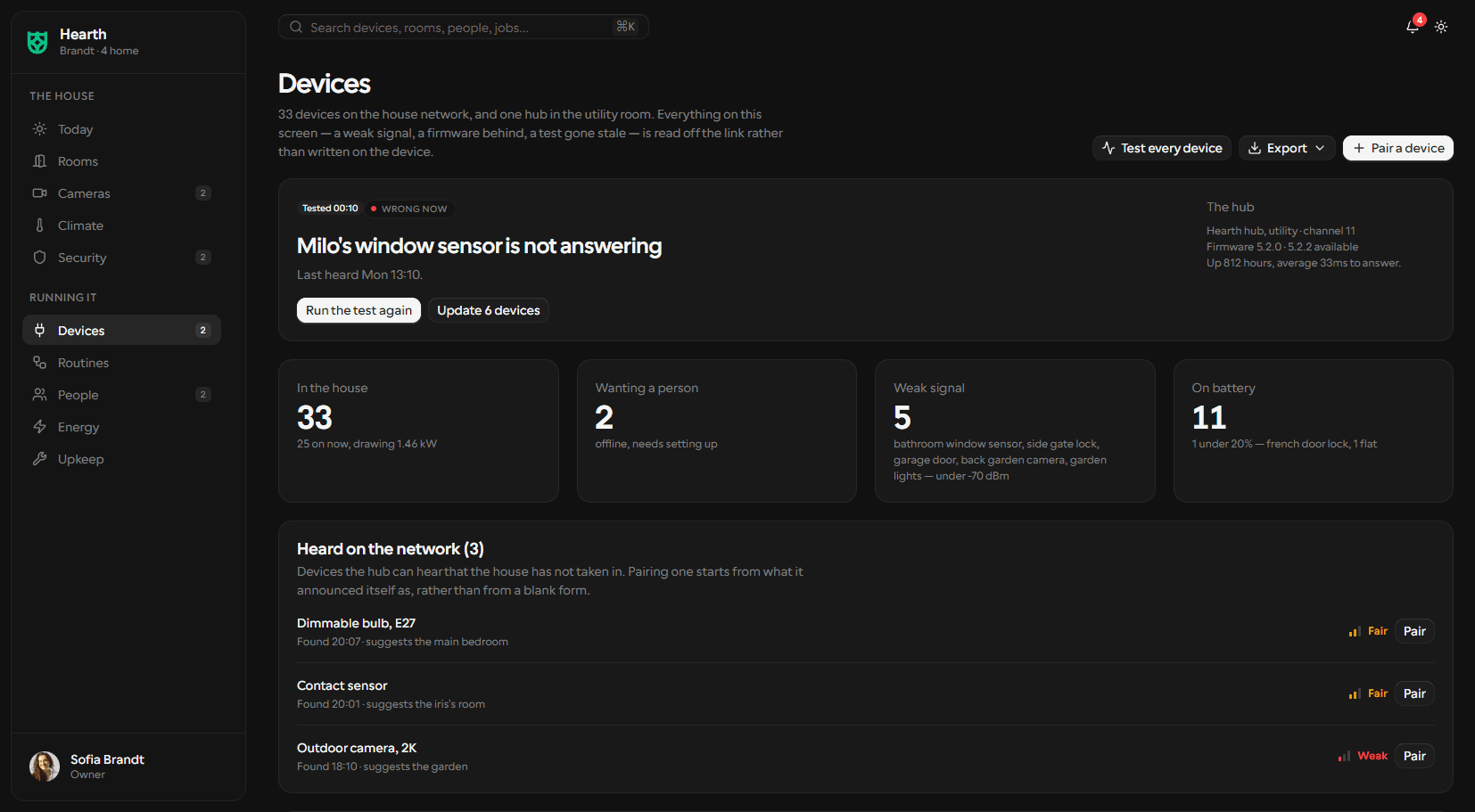
Not a register: the hub’s verdict, what it can hear but has not taken in, what wants a person, then the list. A device that cannot answer is left out of the run and named, rather than failed.
- “Milo’s window sensor is not answering” — last heard Mon 13:10, the only failure of 33
- “Hearth hub, utility · channel 11 · firmware 5.2.0 · 5.2.2 available”, 33ms to answer on average
- 5 under −70 dBm, 11 on battery with 1 of them flat, 6 behind on firmware
What the house buys, and when it is cheap
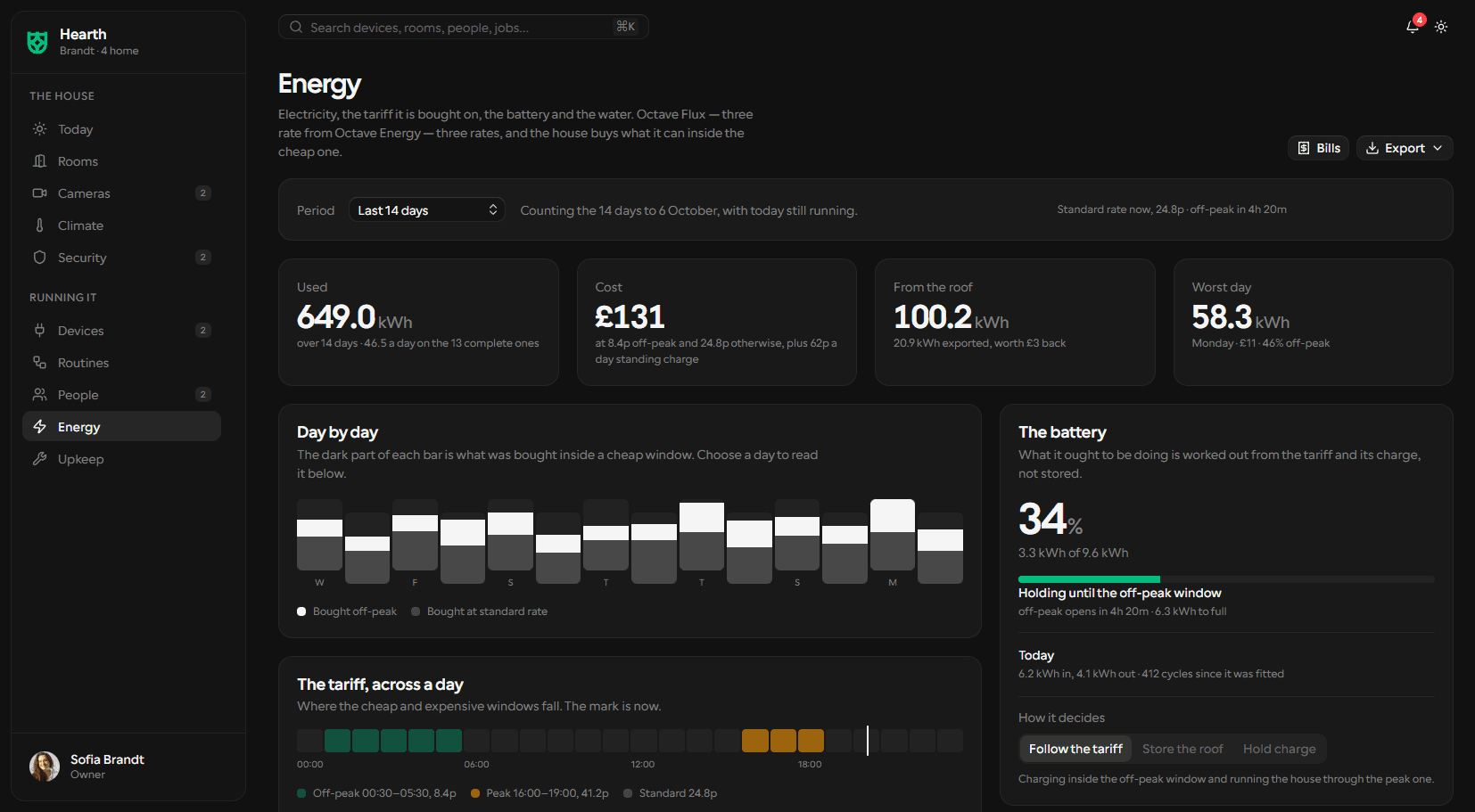
Electricity, its tariff, the battery and the water, over a period the reader picks. A bill is what a reading turns into, and what the battery ought to do is worked out from the tariff and its charge.
- 649.0 kWh over 14 days — 46.5 a day across the 13 complete ones, with today still running
- £131 at 8.4p off-peak and 24.8p otherwise, plus 62p a day standing charge
- The battery at 34%, holding until the off-peak window opens in 4h 20m
Whether the house can rely on a device is stored. Everything else is worked out.
The value every device list seems to need is not here: no low battery, no needs attention. Both are derived at render — the level against the household’s own threshold, and wanting a person from one predicate the nav badge, the tab count and the row all read.
03The awkward cases →The fixture set was written to make screens fail.
None of these is hypothetical. Each one is a record in the fixture, and each one is why a figure two screens away is worked out at render rather than written down.
04The audit →Two screens disagreed about the same two cameras.
The connection test failed anything not online, so running it read “3 devices are not answering” while the figure beneath it said 2, and the cameras screen called those same two updating and never set up. It now fails only a device that could have answered. Two more: one device’s timestamp was being read as all three, and pairing wrote a device but no camera record.
05Back to the top →Reckon
The rules travel.
A house is hardest.
No shift handover, no audit trail anybody is paid to keep, and an operator with a coat on. If the derivations hold here they hold in a warehouse.